



The Empty House Dilemma: Managing Indoor Comfort When School Resumes
The September early fall transition is officially here, meaning the kids are back in class, the house is suddenly quiet during the day, and it is the perfect time for upgrading your thermostat scheduling for the back-to-school routine. Here at Mountain View Heating, our team often notices that for the past few months, your cooling system has likely been running on a steady, predictable summer schedule designed for a house full of people. Now, that same schedule is actively cooling an empty house for seven to eight hours a day, wasting significant energy and putting unnecessary wear and tear on your equipment.
The challenge most homeowners face is finding the perfect balance between daytime energy efficiency and returning to a comfortable home in the afternoon. Leaving the system running at full capacity while no one is home is wasteful, but shutting it off completely means you will walk into an uncomfortably stuffy—or surprisingly chilly—house at 4:00 p.m. The solution lies in strategic setback temperatures and proper daily scheduling. By making a few targeted adjustments to how your system operates during those empty hours, you can optimize your indoor climate for the exact moments your family needs it.
To ensure your system is ready for the seasonal shift, explore our comprehensive home heating systems and learn how a routine HVAC maintenance plan can keep your equipment running smoothly year-round.
Navigating Massive Temperature Swings in the High Desert
Standard, generalized national energy advice often tells homeowners to simply "set it and forget it" when it comes to their thermostats. However, our technicians know firsthand that this advice completely fails to account for the unique climate realities of the Bend high desert. In our years of servicing Central Oregon homes, we see how early fall brings dramatic diurnal temperature shifts, often swinging 30 to 40 degrees within a single 24-hour period. You might wake up to frosty, near-freezing conditions, only to experience intense sunshine and 80-degree heat by mid-afternoon.
This massive daily fluctuation creates a notorious trap for automated climate control: your system might be forced into heating mode in the early morning, and then triggered into cooling mode just a few hours later. If your daytime setbacks are not configured correctly, your HVAC equipment ends up fighting against itself, wasting energy to offset the natural solar heat gain of the afternoon.
The Morning Heating Demand
During the September early fall transition, mornings are crisp. As your family wakes up, showers, and prepares for work and school, the house needs reliable warmth. However, our team advises against pushing your furnace or heat pump to quickly blast hot air for just 45 minutes before everyone rushes out the door, as it is highly inefficient. The goal is to provide just enough ambient warmth to make the morning routine comfortable, without demanding so much heat that the system is still running its cycle right as the last person locks the front door.
The Afternoon Solar Gain
Once the house is empty, the high desert sun takes over. Even as outdoor air temperatures begin to cool later in the day, the intense afternoon sunlight beaming through your windows warms the interior of your empty house. If your thermostat is still operating on a rigid summer schedule, this passive solar heat gain might trigger your air conditioner to turn on unnecessarily. By combining smart thermostat scheduling with passive temperature control—like closing the blinds on south-facing windows before you leave for the day—you can prevent your cooling system from running while the house is empty.
• 6:00 AM - 8:00 AM — High Desert Climate Factor: Frosty, near-freezing temperatures — HVAC System Risk: Overworking the furnace for a brief period — Strategic Solution: Moderate heating target, stopping before departure
• 10:00 AM - 2:00 PM — High Desert Climate Factor: Rapidly warming outdoor air — HVAC System Risk: Unnecessary cycling as the house naturally warms — Strategic Solution: Deep setback; let the house float naturally
• 2:00 PM - 5:00 PM — High Desert Climate Factor: Peak solar heat gain through windows — HVAC System Risk: Triggering the AC while the house is empty — Strategic Solution: Use window coverings; delay cooling recovery
Structuring the Ideal 4-Block Thermostat Schedule for Fall
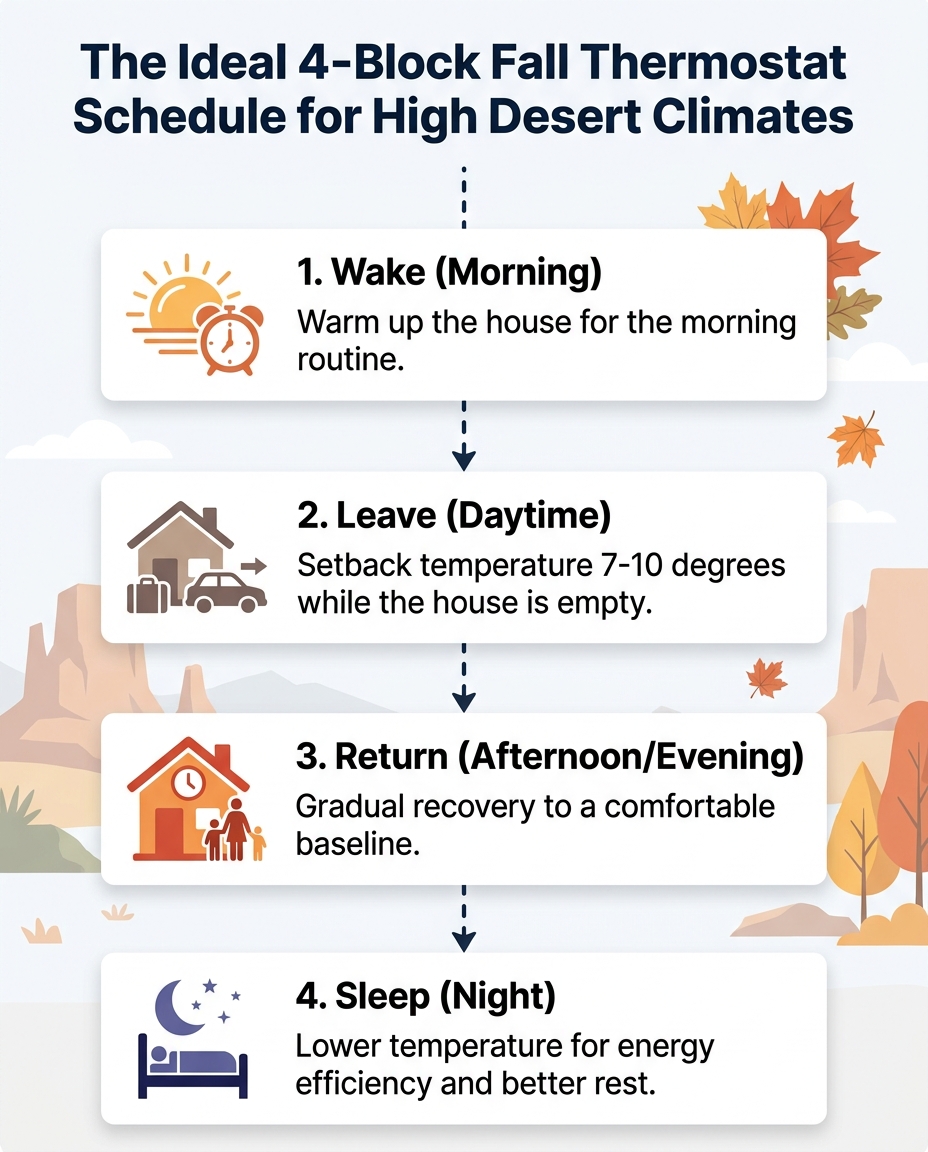
The most effective way to manage these dramatic temperature shifts is by utilizing a 4-block scheduling method. This approach aligns perfectly with the structured back-to-school routine, dividing your day into four distinct phases: Wake, Leave, Return, and Sleep. The U.S. Department of Energy recommends adjusting your thermostat by 7 to 10 degrees from its normal setting for the 8 hours you are away, which can significantly reduce your annual heating and cooling energy usage.
Here is how our experts recommend optimizing those four blocks for the September early fall transition. If you are unsure how to program these specific blocks into your current unit, reading up on understanding your thermostat's modes and settings is a great first step.
Wake and Leave Settings
1. The Wake Block: Set your thermostat to reach your preferred morning temperature about 15 to 20 minutes before your alarm goes off. This ensures the house is comfortable when you step out of bed. Keep this target temperature moderate to avoid over-taxing the system.
2. The Leave Block: This is where your energy savings happen. Program the setback to initiate 20 to 30 minutes before the last person actually leaves the house. The home will retain its ambient temperature long enough for everyone to get out the door comfortably. Drop your heating target by 7 to 10 degrees, and raise your cooling target similarly, creating a wide "deadband" where the system simply rests.
Return and Sleep Adjustments
1. The Return Block: Timing is everything here. You want the recovery cycle to begin just before the school bus arrives or you pull into the driveway. Do not wait until you walk through the door to adjust the temperature, or you will be tempted to crank it to an extreme setting to force it to work faster (which does not actually heat or cool the home any quicker).
2. The Sleep Block: As the Bend high desert temperatures plummet at night, lower your indoor target temperature. Cooler sleeping environments are proven to promote better rest, and reducing the heating demand overnight is one of the easiest ways to improve your home's overall efficiency.

Preventing Your HVAC System from Overworking During the Afternoon Recovery
One of the most common mistakes our Mountain View Heating technicians see homeowners make during the back-to-school season is demanding too much from their HVAC system all at once. When the house has been sitting empty and the temperature has drifted by 10 degrees, asking the system to close that gap in 15 minutes causes immense mechanical stress. This is known as "recovery time," and handling it incorrectly can lead to premature wear and tear on your equipment.
Extreme temperature swings can cause systems to fight themselves. If you manually crank the thermostat up to 75 degrees because you feel chilly when you walk in, the furnace will run at full blast. A few hours later, when the house is too hot and the afternoon sun is still shining, you might switch it to cooling mode. This constant back-and-forth is highly inefficient. We see this pattern on service calls throughout Bend all the time. In fact, when one local property owner sought guidance from our team on the safe maintenance and operation of a remote rental home's HVAC system, they learned firsthand how crucial proper recovery is. After one of our professional technicians walked them through the system's capabilities, they gained the confidence to set realistic, gradual recovery periods rather than demanding instant, extreme temperature changes.
Understanding Gradual Recovery
A slow, deliberate ramp-up is always better for mechanical longevity than a sudden, massive demand. When your system operates steadily over a slightly longer period, it uses less energy than it does when constantly turning on and off to chase wild temperature swings. By programming your thermostat to begin its recovery 30 to 45 minutes before you arrive home, the equipment can ease the house back to a comfortable baseline smoothly. This gradual approach protects your compressor, reduces stress on your heat exchanger, and prevents the unexpected system failures that frequently happen during transition seasons when equipment is pushed too hard.
Leveraging Smart Technology to Automate Your Daily Setbacks
If managing a 4-block schedule sounds complicated, modern technology has completely removed the guesswork. Upgrading from a manual or basic programmable unit to an intuitive smart system allows you to automate your daily setbacks effortlessly. Our installation team at Mountain View Heating understands exactly how to configure these smart systems to handle Deschutes County's unique climate efficiently, ensuring your home stays comfortable without wasting energy.
Modern smart thermostats and HVAC products offer features specifically designed for the unpredictable nature of family life:
• Remote Access and Monitoring: Parents can check the indoor temperature from their smartphones while at work, ensuring the house is comfortable before the kids get off the bus.
• Energy Usage Reports: These systems track exactly when your heating and cooling equipment runs, allowing you to tweak your schedule for maximum efficiency.
• Filter Change Alerts: Smart units monitor runtime and will notify you when it is time to replace your air filter, protecting your system's airflow.
• Multi-Zone Control: If your home is zoned, you can set different schedules for different areas—focusing comfort on the living room in the afternoon and the bedrooms at night.
Geofencing for Unpredictable Schedules
The back-to-school season is rarely perfectly predictable. Kids come home early for half-days, sports practices get canceled, and sick days happen. Geofencing uses the location services on your smartphone to create a virtual perimeter around your home. When you cross that boundary, the thermostat automatically overrides the standard "Leave" schedule and begins conditioning the house. It is the perfect solution for varied after-school activities, ensuring you never walk into an uncomfortable home, even if you arrive hours earlier than planned.
Adaptive Intelligent Recovery
Adaptive recovery is a feature where the thermostat actively learns your home's specific thermal profile. Instead of you guessing how long it takes to heat the house by 5 degrees, the thermostat calculates it based on the current outdoor temperature and your system's historical performance. If you want the house at 68 degrees by 4:00 p.m., the thermostat decides exactly when to start the "Return" block to hit that target precisely on time.
Why Fall Scheduling Strategies Rely on a Well-Maintained System
Even the most perfectly optimized thermostat schedule cannot overcome the burden of neglected, struggling HVAC equipment. A smart thermostat is ultimately just a command center; it relies entirely on the physical health of your furnace and air conditioner to execute those commands. If your system is battling restricted airflow from dirty filters or struggling with a failing blower motor, it will take twice as long to recover from a daytime setback, erasing any energy efficiency you hoped to gain.
Routine pre-season tune-ups are essential before the heavy winter demand begins. During these visits, technicians clean internal components, calibrate sensors, and ensure the system responds accurately to your thermostat. Clear communication during these appointments is vital. During a recent fall tune-up, one of our maintenance technicians provided a homeowner with an easy-to-understand explanation of their heating system. That clear communication helped them realize exactly how their equipment operates, giving them the confidence to manage their settings properly. Keeping your system in top condition through a Comfort Club membership ensures that when your thermostat calls for heat on a frosty September morning, your equipment delivers safely and efficiently.
Frequently Asked Questions About Fall Thermostat Settings
What is the best thermostat schedule for an empty house during the day?
Our team highly recommends a 4-block system: Wake, Leave, Return, and Sleep. During the "Leave" block, when the house is empty, you should implement a setback of 7 to 10 degrees from your standard comfort level. This prevents the system from cycling on and off to condition empty rooms, while still keeping the baseline temperature manageable for a quick recovery when you return.
Should I turn my thermostat completely off when I go to work?
No, turning your system completely off is highly discouraged. If you shut the system down, your home's interior temperature will drift to extremes, meaning your HVAC equipment will have to run continuously for hours to recover when you get home. A moderate 7- to 10-degree setback saves energy without forcing your system to overwork during the recovery phase.
How do I adjust my thermostat for unpredictable fall weather?
To handle unpredictable fall weather, widen the gap between your heating and cooling setpoints (known as the deadband). For example, set your heat to trigger only if the house drops below 62 degrees, and the AC to trigger only if it rises above 78 degrees. This allows the home's temperature to float naturally throughout the day without the system constantly fighting the changing weather.
What temperature should I leave my house at during the day in autumn?
While personal comfort varies, a widely recommended daytime autumn setting for an empty house is around 60 to 62 degrees for heating, and 78 to 80 degrees for cooling. This prevents the furnace from running during chilly mornings once you have left, and stops the AC from kicking on during warm afternoon solar heat gain.
How does a smart thermostat handle massive daily temperature swings?
Smart thermostats handle large temperature swings using adaptive recovery and local weather data integration. They monitor the outdoor temperature and learn exactly how long your specific home takes to heat or cool. This allows them to ease the system into a gradual recovery cycle, preventing the aggressive, sudden cycling that stresses mechanical components during extreme daily shifts.
Optimize Your Home's Efficiency This School Year
Adapting your thermostat schedule to the back-to-school routine is one of the smartest ways to balance daily comfort with long-term energy consciousness. By understanding the unique challenges of the Bend high desert and utilizing strategic daytime setbacks, you can stop paying to heat and cool an empty house. Take the time to program your daily blocks, explore the benefits of smart technology, and ensure your equipment is professionally maintained by the Mountain View Heating team so your home is always perfectly comfortable the moment you walk through the door.