


Are Static Labels Misleading Your August Energy Predictions?
If you are trying to get your Mini Split Wattage Explained: Tracking Your Actual August Energy Costs, the very first question to ask is whether you are looking at the static maximum rating on your unit's manufacturing sticker. Here at Mountain View Heating, our team frequently speaks with homeowners who attempt to calculate their late-summer utility usage by taking that maximum wattage number and multiplying it by the hours the system runs. The short answer is that this math will almost always give you a wildly inaccurate, inflated number. Static wattage labels represent the absolute maximum electrical capacity the equipment can draw under extreme load, not its actual, minute-by-minute running consumption.
This common misunderstanding stems from how older, traditional cooling equipment was built. Legacy units operated on a simple binary: they were either completely off, or they were running at 100% maximum capacity. Modern ductless systems, however, utilize variable-speed inverter technology. This means the system continuously adjusts its power draw based on the immediate needs of the room. When you rely on a static label to predict your August cooling bills, you completely ignore the dynamic, highly efficient nature of how these modern systems actually operate.
For a comprehensive approach to home comfort, understanding how modern HVAC systems differ from traditional setups is essential, especially when upgrading to energy-efficient ductless mini splits. The core decision point for late-summer cooling isn't just about the equipment itself, but how you operate it. Deciding whether to leave the system running continuously or to cycle it on and off during August heat waves will dramatically impact how much power the inverter actually draws.
The Mechanics of Variable-Speed Inverters and Power Draw
To truly understand your energy consumption, you have to look at the mechanics of the variable-speed inverter. Unlike a standard compressor that blasts at full volume until the thermostat clicks off, an inverter acts more like the accelerator pedal in a car. It modulates the compressor speed smoothly, drawing only the exact amount of electricity required to maintain the desired indoor temperature.
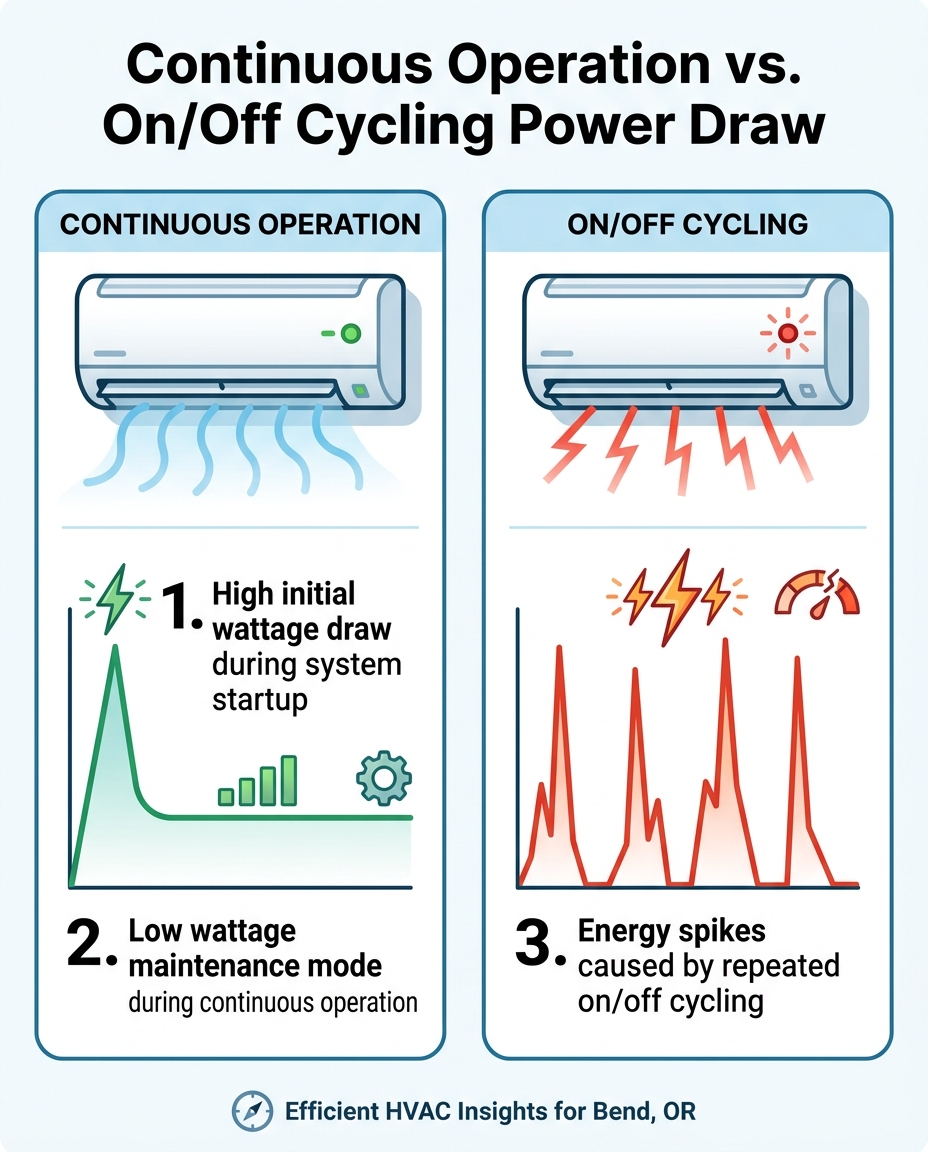
When you first turn the system on in a hot room, the inverter will draw a high amount of wattage to rapidly remove the accumulated heat. This is the startup phase, and we always remind our Bend customers that it is the only time the system typically pulls anything close to the maximum wattage listed on the manufacturer's static label. However, this high-draw period is relatively brief.
Once the indoor space reaches your set target temperature, the true benefit of the technology takes over. The system transitions into a low-wattage maintenance mode. Instead of shutting down completely, the compressor ramps down to a very slow, continuous speed. This variable wattage draw (ramping down from max capacity to low-wattage maintenance mode) is what makes these systems incredibly efficient. They gently trickle cooling into the room to offset the heat creeping through your walls and windows, drawing a fraction of their maximum rated power.
When comparing different heat pump options, this modulation capability is the primary factor in long-term efficiency. Traditional on/off systems experience a massive electrical surge every single time they start up. By avoiding these constant, heavy electrical spikes and settling into a smooth maintenance rhythm, variable-speed inverters drastically lower the overall daily power consumption, even during the hottest parts of the year.
How Central Oregon's August Weather Impacts Actual Mini Split Wattage
Energy draw does not happen in a vacuum; it is entirely dependent on the required cooling load, which is dictated by local weather patterns. In August, the high-desert climate of Central Oregon presents a unique set of challenges and opportunities for inverter-driven equipment. With summer temperatures regularly exceeding 90°F during the afternoon, the cooling load on your home peaks, forcing the system to work harder and temporarily increase its wattage draw to keep up with the intense solar heat gain.
However, Bend and the surrounding high-desert areas are known for massive diurnal temperature swings. While the days are exceptionally hot, the decreasing daylight hours of late summer bring significantly cooler evenings and nights. As the outdoor temperature plummets after sunset, the thermal load on your home drops rapidly. This is where static energy calculations completely fall apart.
Because the outdoor air is cooler, the system does not have to work nearly as hard to reject heat. The variable-speed inverter senses this reduced load and automatically throttles down. Throughout the cool night and early morning, the system operates in its absolute lowest-wattage state. If you calculated your energy usage based on peak afternoon heat, you would miss out on the massive efficiency gains achieved during the cool high-desert nights.
As local Central Oregon experts who understand exactly how high-desert summers impact utility bills, our Mountain View Heating technicians know that air conditioning cooling strategies must account for these regional shifts. In our years of installing and servicing these systems, we've seen how a static label cannot predict the relief of a 50°F August night, but your inverter system is specifically designed to take advantage of it, ramping down power consumption and stabilizing your overall late-summer energy profile.
The 'Leave It On vs. Turn It Off' Efficiency Debate
One of the most persistent myths in home cooling is that turning your system completely off when you leave the house will automatically save energy. While this logic applied to legacy single-stage equipment, applying it to variable-speed inverters actually causes them to use more power. This brings us to the operational decision point of late-summer cooling: the "leave it on vs. turn it off" debate, a topic our team addresses on almost every August service call.
When you turn the system off during a hot August day, the thermal mass of your home—the walls, the floors, the furniture—absorbs heat. When you return home and turn the system back on, the inverter must operate at maximum capacity for an extended period. It is no longer just cooling the air; it has to extract deep-seated heat from every physical object in the room. This prolonged high-wattage surge completely negates any energy you saved while the unit was off.
Conversely, leaving the thermostat set to a consistent, reasonable temperature allows the inverter to stay in its low-wattage maintenance mode all day. It continuously removes small amounts of heat as it enters the home, preventing the thermal mass from warming up in the first place. Understanding the real electricity draw of mini splits means recognizing that continuous, low-level operation is mathematically more efficient than repeated, high-intensity recovery cycles.
Continuous Operation vs. On/Off Cycling
To visualize how these two operational strategies impact your system's power draw, review the comparison below:
• Continuous Operation — Compressor Behavior: Smoothly modulates to match the exact cooling load. — Impact on Wattage Draw: Stays in low-wattage maintenance mode; avoids startup spikes. — Late-Summer Efficiency: Highly efficient; maintains consistent comfort with minimal power.
• On/Off Cycling — Compressor Behavior: Forces system to shut down and reboot repeatedly. — Impact on Wattage Draw: Triggers massive electrical surges upon every single startup. — Late-Summer Efficiency: Inefficient; uses excess power to constantly re-cool thermal mass.
• Thermostat Setbacks (Extreme) — Compressor Behavior: System remains off during peak heat, then runs at 100%. — Impact on Wattage Draw: Prolonged maximum-wattage draw to overcome deep heat saturation. — Late-Summer Efficiency: Poor; stresses the equipment and spikes daily consumption.

Late-Summer System Stress and Maintenance Needs
By the time August arrives, your cooling equipment has likely been running consistently for several months. Prolonged high temperatures in June and July can put significant stress on even the most advanced systems. If a unit is struggling to breathe due to neglected maintenance, the inverter will be forced to draw more wattage just to achieve basic airflow, completely undermining its high-efficiency design.
During a brutal stretch of high temperatures last June, our Mountain View Heating service teams worked extended hours to address local homeowners' heat pump systems that had been severely stressed by the early peak season demand. The underlying issue in many of the late-summer service calls we run is often traced back to restricted airflow or dirty coils, which prevent the system from naturally ramping down into its low-wattage maintenance mode.
To ensure your system can properly reach and sustain its most efficient operational state during late-summer cooling, certain end-of-season checks are necessary:
1. Inspect and clean the air filters: A clogged filter forces the blower motor to work harder, increasing electrical draw and preventing the system from properly distributing conditioned air.
2. Clear the outdoor unit: August winds often blow dust, pollen, and debris into the outdoor condenser coil. A blocked coil restricts heat transfer, forcing the compressor to stay in high-draw modes longer.
3. Verify continuous airflow: Ensure that indoor vents and air handlers are not blocked by furniture or curtains. Restricted airflow alters the temperature sensors, confusing the inverter and causing unnecessary cycling.
4. Schedule professional diagnostics: A technician can measure the actual electrical draw of the compressor to confirm it is successfully ramping down as designed, rather than staying locked in a high-wattage state due to an underlying mechanical stressor.
Professional checkups ensure that the variable wattage draw (ramping down from max capacity to low-wattage maintenance mode) is functioning precisely as the manufacturer intended, keeping your August utility usage in check.
Frequently Asked Questions: Do Mini Splits Use a Lot of Electricity?
When our Bend-area customers start tracking their August energy usage, questions about electrical consumption naturally arise. The short answer to "do mini splits use a lot of electricity?" is no; they are widely considered one of the most energy-efficient climate control solutions available today. Because they utilize variable-speed inverter technology, they use significantly less electricity than traditional on/off systems by ramping down power consumption once the target temperature is reached. Below is a detailed breakdown of common questions regarding system efficiency and power draw.
Do mini splits use less electricity than central air?
Yes, ductless systems generally use much less electricity than traditional central air conditioning. The primary reason is the elimination of ductwork, which can account for massive energy losses through leaks and poor insulation in attics or crawlspaces. Furthermore, the advanced inverter technology prevents the massive energy spikes associated with the hard starts of traditional central air compressors. Instead of blasting at full power and shutting down, the ductless unit modulates its speed, resulting in smoother, lower overall power consumption.
How much electricity does a mini split use per month?
Monthly usage depends heavily on the specific cooling load of your home, the quality of your insulation, and the outdoor temperatures in your region. Because variable-speed units adjust their power draw daily and even hourly, your August usage will differ significantly from your usage in milder months like June or September. There is no single flat rate for monthly consumption; it fluctuates dynamically based on how hard the system has to work to combat the outdoor heat.
Should I leave my mini split on all the time in summer?
Yes, leaving your system running continuously at a comfortable set point is the most efficient way to operate it during the summer. By leaving it on, you allow the inverter to utilize its low-wattage maintenance mode. If you turn it off when you leave for work and back on when you return, the system has to run at maximum capacity for hours to extract the heat that soaked into your walls and furniture, which ultimately uses more electricity than simply maintaining a steady temperature all day.
What is the average mini split wattage?
The average running wattage is a moving target because of how the inverter modulates. While a system might have a maximum rating of several thousand watts on its warning label, its actual running wattage during maintenance mode can drop to a mere fraction of that number. Once the room is cooled, the system only draws the minimal average wattage required to keep the air stable, making static averages very difficult to apply to daily real-world operation.
How do high-desert temperature swings affect mini split power draw?
High-desert climates, like Central Oregon, feature hot afternoons and very cool nights, which directly impacts power draw. During a 95°F afternoon, the system will draw more wattage to keep up with the intense solar heat. However, as the sun sets and outdoor temperatures drop into the 50s, the system's sensors detect the reduced load. The inverter automatically throttles down the power draw, taking advantage of the cool night air to run at maximum efficiency with minimal electrical consumption.
Optimize Your Late-Summer Cooling Strategy
Understanding the mechanics behind variable-speed inverters completely changes how you view your August / late-summer cooling. By recognizing that static maximum-wattage labels are misleading, you can make smarter decisions about how to operate your equipment. The key to maximizing efficiency is trusting the technology: allow the system to run continuously so it can settle into its low-wattage maintenance mode, rather than forcing it into high-draw recovery cycles by constantly turning it off and on.
If you notice that your system seems to be running at maximum capacity constantly, or if it is struggling to maintain a comfortable temperature despite continuous operation, it may be suffering from end-of-season stress. Dirty components and restricted airflow will force any system to draw excess power. Our team recommends scheduling a professional inspection to ensure your equipment is modulating correctly, keeping your home perfectly comfortable without wasting unnecessary electricity.