


Surviving the September Swing: Frosty Dawns and Blistering Afternoons
Early fall in the high desert is just around the corner, bringing a unique set of weather challenges and introducing the transition period: managing frosty mornings and 80-degree afternoons. Before the first freeze hits, there is one critical detail every homeowner must check: the thermostat. Leaving your equipment on generic settings during these dramatic daily swings causes it to fight itself, wasting energy and stressing internal components. Fortunately, an optimized HVAC system, backed by routine seasonal maintenance, handles these rapid shifts effortlessly. Here is how you can adjust your settings to protect your equipment and stay comfortable all day long.
Living at an elevation of 3,623 feet in Bend brings a very specific set of weather phenomena that most standard heating and cooling manuals simply do not account for. The high desert is famous for its rapid radiative cooling at night. Because the air is dry and the elevation is high, the heat absorbed by the earth during the day escapes rapidly into the atmosphere as soon as the sun goes down. This leaves you with a frosty dawn that demands immediate heat.
However, that same high-elevation environment allows for intense solar heating during the day. By the time 3:00 PM rolls around, the sun is beating down on your roof, heating the thermal mass of your home, and pushing indoor temperatures up rapidly. This creates a massive 50-degree daily temperature swing (frosty mornings to 80-degree afternoons). For a homeowner, this means peeling off layers of sweaters as the day goes on. For your home's climate control system, it represents one of the most mechanically demanding environments possible.
When the outdoor temperature shifts by 50 degrees in a matter of hours, a system left on default settings will inevitably struggle. It will run the furnace aggressively to combat the morning frost, overshoot the ideal temperature slightly, and then sit idle while the sun bakes the house. A few hours later, the system detects the rising heat and triggers the cooling cycle to undo the very warmth it worked so hard to create earlier. This constant switching is inefficient, expensive, and entirely preventable.
Why a 50-Degree Daily Shift Strains Your Equipment
Heating and cooling systems are engineered to operate in long, steady cycles. They perform best when they can turn on, reach a stable operating temperature, satisfy the thermostat's demand, and then shut down for an extended rest. A 50-degree daily temperature swing (frosty mornings to 80-degree afternoons) disrupts this natural rhythm completely.
When your system rapidly switches between heating mode and cooling mode on the same day, it never truly gets to rest. The furnace works overtime in the morning, generating residual heat that becomes trapped in your ductwork and the physical structure of your home. A few hours later, the air conditioner has to battle not only the rising outdoor temperature but also the lingering warmth left behind by the morning heating cycle.
When systems are constantly stressed by these extreme swings, parts wear out faster. We see this pattern frequently. For example, one customer who has relied on our team for ongoing maintenance since 2007 experienced an unexpected issue during a similar transition season. Even with a long-term technician having recently retired, our team acted quickly, diagnosing the stressed component and resolving the issue to the customer's complete satisfaction. That kind of rapid response is critical when your system works this hard, but preventing the strain in the first place is always the better approach.
The Tug-of-War Effect
This daily battle between heating and cooling is known as the "tug-of-war effect," and it carries several distinct mechanical and financial consequences for your household.
1. Accelerated component wear: Rapidly cycling between heat and cool puts immense stress on contactors, capacitors, and blower motors. These parts are designed for seasonal shifts, not daily reversals.
2. Short-cycling damage: When the system turns on and off too quickly, it enters a state of short-cycling. The compressor never runs long enough to properly lubricate itself, and the heat exchanger expands and contracts too rapidly.
3. Wasted energy consumption: Every time a system starts up, it draws a massive surge of electricity. Constant starting and stopping consumes significantly more power than running one long, steady cycle.
4. Uneven indoor comfort: Because the system is constantly chasing a moving target, you will likely experience cold spots, hot spots, and drafts as the blower fan pushes air that hasn't fully reached the desired temperature.
Ultimately, an overtaxed system is far more prone to complicated breakdowns right when you need it most. The wear and tear accumulates invisibly until a critical component fails, often during the first major cold snap of the year.
The Hidden Trap of Standard Auto Settings in the High Desert
Modern thermostats are incredibly smart, but they are programmed for average climates. The "Auto Changeover" mode is a perfect example of a feature that works beautifully in mild, coastal areas but becomes a hidden trap in Central Oregon.
Auto Changeover mode allows the thermostat to automatically switch back and forth between heating and cooling based on the indoor temperature. You set a heating target (say, 68°F) and a cooling target (say, 74°F). If the house drops below 68°F, the furnace turns on. If it rises above 74°F, the AC turns on. To learn more about how these features interact, reviewing a guide on thermostat modes and settings can clarify the basics.
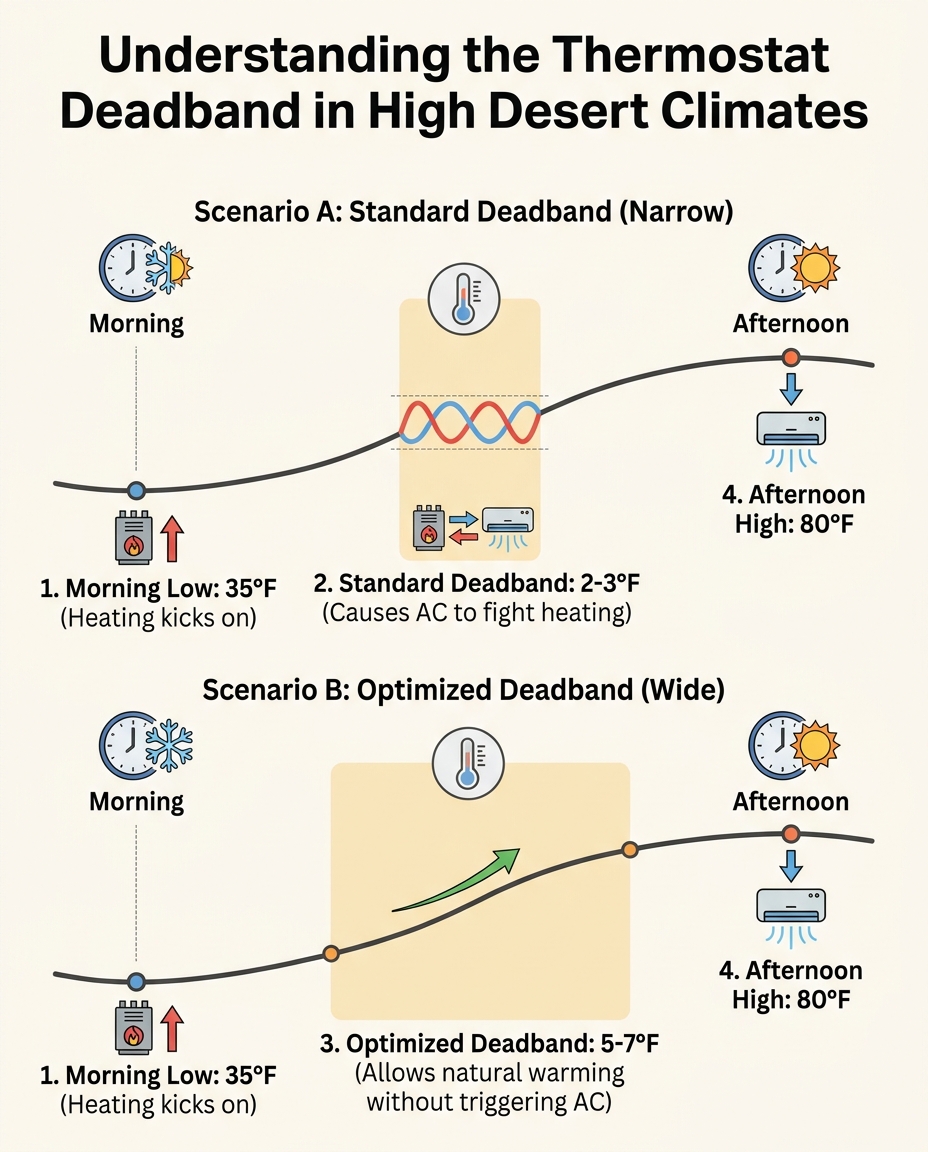
The problem lies in the default factory settings. Most manufacturer default settings assume a steady seasonal drop in temperature, ignoring the rapid 50-degree diurnal shifts specific to Central Oregon's September climate. Out of the box, a standard thermostat differential (the gap between the heating and cooling setpoints) might be as narrow as 2 to 3 degrees.
In Bend, OR, a 3-degree differential is a recipe for disaster during the fall transition. The furnace will easily hit 70°F by 8:00 AM. Then, the intense high-desert sun hits the windows. By 1:00 PM, the house naturally warms up to 73°F. Because the differential is so narrow, the thermostat panics and kicks on the AC to cool the house back down—even though the outside temperature will plunge back to freezing in just a few hours.
As local experts who understand exactly how Bend's extreme daily swings stress a system, Mountain View Heating offers tailored advice rather than generic manual recommendations. We know that standard settings simply do not work here. You need custom programming tailored to the region to stop your system from fighting the natural warming of the afternoon.
How to Configure a Wider Deadband to Stop System Fighting
The solution to the Auto Changeover trap is adjusting a setting called the "deadband." The thermostat deadband is the temperature gap between when the heating stops and the cooling begins. By widening this gap, you give your home permission to warm up naturally without triggering the air conditioning.
For a 50-degree daily temperature swing (frosty mornings to 80-degree afternoons), a deadband of 5 to 7 degrees is highly recommended. This tells the system: "Keep me warm in the morning, but let the house drift naturally in the afternoon. Do not turn on the AC unless it gets uncomfortably hot."
Steps to widen your thermostat deadband for fall transition weather:
• Access the main menu: Open your thermostat's settings menu (often a gear icon on smart thermostats or a "Menu" button on digital models).
• Locate the Auto mode settings: Look for "Auto Changeover," "System Setup," or "Advanced Settings."
• Find the differential or deadband option: This may be labeled as "Heat/Cool Gap," "Deadband," or "Temperature Differential."
• Increase the gap to 5-7 degrees: Adjust the setting so there is a minimum of 5 to 7 degrees between your heating setpoint and cooling setpoint (e.g., Heat at 67°F, Cool at 74°F).
• Save and monitor: Save the settings and observe how the system behaves over the next 24 hours. You should notice the AC staying off during the mild afternoon hours.
Finding the Comfort Sweet Spot
Widening the deadband requires a slight adjustment to your expectations of indoor comfort. You are allowing the house to fluctuate a bit more than it would in the dead of winter. However, this gradual drift is usually quite comfortable. The house warms up slowly with the sun, and by the time it reaches the top of the deadband, the sun is setting, and the house begins to cool naturally.
Adjust the deadband gradually to find what works for your household. If a 7-degree gap feels too wide, try 5 degrees. The goal is to balance maximum energy savings with a comfortable living environment, ensuring the system only runs when absolutely necessary.

Using Strategic Scheduling to Outsmart the Afternoon Heat
Beyond widening the deadband, you can outsmart the extreme September weather swings by using strategic scheduling. Programmable thermostats allow you to create distinct temperature blocks throughout the day. By aligning these blocks with the natural movement of the sun, you can utilize passive solar heating and avoid unnecessary system triggers.
Passive solar heating is free energy. Instead of running the furnace to keep the house at 70°F all afternoon, you can open the curtains on south-facing windows and let the sun do the heavy lifting. By programming the thermostat to drop the heating setpoint slightly in the afternoon, you prevent the furnace from competing with the sun.
Strategic scheduling can save up to 10% a year on heating and cooling costs when properly executed. Here is a highly effective scheduling strategy for the high desert transition season:
• Morning (6:00 AM) — Thermostat Action: Heating set to 68°F to combat the overnight frost. — Homeowner Action: Keep blinds closed to retain the heat generated by the furnace.
• Mid-Day (11:00 AM) — Thermostat Action: Heating drops to 64°F; Cooling set to 75°F. — Homeowner Action: Open south-facing curtains to allow passive solar heating into the home.
• Afternoon (3:00 PM) — Thermostat Action: System remains in wide deadband mode. — Homeowner Action: Close blinds on west-facing windows to block the most intense afternoon glare.
• Evening (8:00 PM) — Thermostat Action: Heating returns to 66°F as the outdoor temperature plummets. — Homeowner Action: Close all curtains to trap the warmth inside for the night.
The afternoon dip: The most important part of this schedule is scheduling a slight temperature dip in the mid-afternoon. If the house naturally reaches 73°F at 4:00 PM, you do not want the cooling cycle activating just before the evening chill sets in. By letting the house hold that natural warmth, you give your furnace a head start on the cold night ahead.
Transitioning from Shoulder Season to Full Winter Operations
Eventually, the extreme swings of early fall will give way to consistent, freezing winter temperatures. The 80-degree afternoons will disappear, and your system will shift into full-time heating mode. Because of the immense strain the transition season puts on your equipment, the shoulder season is the absolute critical window for a professional furnace inspection.
During a recent fall visit for routine furnace maintenance in Central Oregon, our technician provided a thorough service and an easy-to-understand explanation of how the transition weather was affecting the customer's specific system. The technician cleaned the burners, checked the safety sensors, and verified the airflow. The outcome was a heating system that was perfectly maintained and a homeowner who fully understood how to operate it efficiently heading into winter.
A thorough seasonal tune-up goes far beyond just swapping out an air filter. It involves a comprehensive safety and performance evaluation. Here is what a professional inspection entails:
• Checking gas lines and connections: Ensuring there are no micro-leaks and that the gas pressure is calibrated correctly for high-altitude operation.
• Testing safety sensors: Verifying that the flame sensor and limit switches are clean and functioning to prevent dangerous overheating.
• Evaluating airflow and blower performance: Measuring the electrical draw of the blower motor to ensure it hasn't been damaged by short-cycling during the fall swings.
• Inspecting the heat exchanger: Looking for hairline cracks that could leak carbon monoxide into the home once the furnace runs constantly in winter.
Reassure yourself that properly maintaining the system now prevents emergency failures during the first true winter storm. When the snow starts falling, you want the peace of mind that comes from knowing your equipment is clean, calibrated, and ready for the long haul.
Frequently Asked Questions About Fall Thermostat Settings
How do you set a thermostat when it's cold in the morning and hot in the afternoon?
The best approach is to use the Auto Changeover mode with a widened temperature gap. Set your heating target lower (around 66°F to 68°F) and your cooling target higher (around 74°F to 76°F). This allows the house to warm up naturally with the sun during the day without prematurely triggering the air conditioning to fight the heat.
What is a thermostat deadband?
A thermostat deadband is the specific range of degrees between the heating setpoint and the cooling setpoint where the system remains completely idle. For example, if heating is set to 68°F and cooling is set to 73°F, the 5-degree gap in between is the deadband. A wider deadband prevents the system from constantly switching back and forth.
Should I leave my thermostat on auto during fall?
Yes, leaving your thermostat on auto is highly convenient during the fall, but only if you have properly configured the differential settings. If your deadband is too narrow, auto mode will cause your system to short-cycle and waste energy. Always ensure there is at least a 5 to 7-degree gap between your heat and cool settings before relying on auto mode during a 50-degree daily temperature swing (frosty mornings to 80-degree afternoons).
Does switching between heat and AC damage the system?
Occasional switching does not cause immediate damage, but rapid, daily switching over a prolonged period accelerates wear and tear. It forces the blower motor, contactors, and capacitors to work constantly without resting. Over time, this "tug-of-war" effect shortens the lifespan of the components and increases the likelihood of a mid-season breakdown.
What is the best temperature differential setting for high desert climates?
In high desert climates that experience massive daily temperature shifts, a differential (or deadband) of 5 to 7 degrees is ideal. This wide gap respects the natural radiative cooling and solar heating of the region, allowing the home's thermal mass to absorb afternoon heat without forcing the AC to fight the natural weather patterns.
Take Control of Your Comfort This Fall
Mastering your thermostat settings is one of the easiest and most effective ways to protect your equipment from unnecessary wear during the unpredictable September transition. By widening your deadband and utilizing strategic scheduling, you stop the furnace and air conditioner from fighting each other, saving energy and preserving the lifespan of your system's critical components.
Clear, safe adjustments to your daily schedules provide incredible peace of mind during unpredictable weather. However, settings alone cannot replace the value of a clean, well-tuned machine. Take control of your comfort this fall by scheduling your pre-winter inspection today. Ensure your system is completely ready for whatever the high desert brings, from frosty dawns to the deepest winter freezes.