


How to Make Sure You're Hiring the Right Person for Your Home's Heating and Cooling
How to verify your HVAC technician's credentials is something every Bend, Oregon homeowner should know before letting anyone touch their furnace, heat pump, or air conditioning system. HVAC systems are complex — they involve electricity, refrigerant chemicals, gas lines, and combustion components like ignitors. When something goes wrong with an unqualified technician, the consequences can range from a voided warranty to serious safety hazards like carbon monoxide exposure or refrigerant leaks.
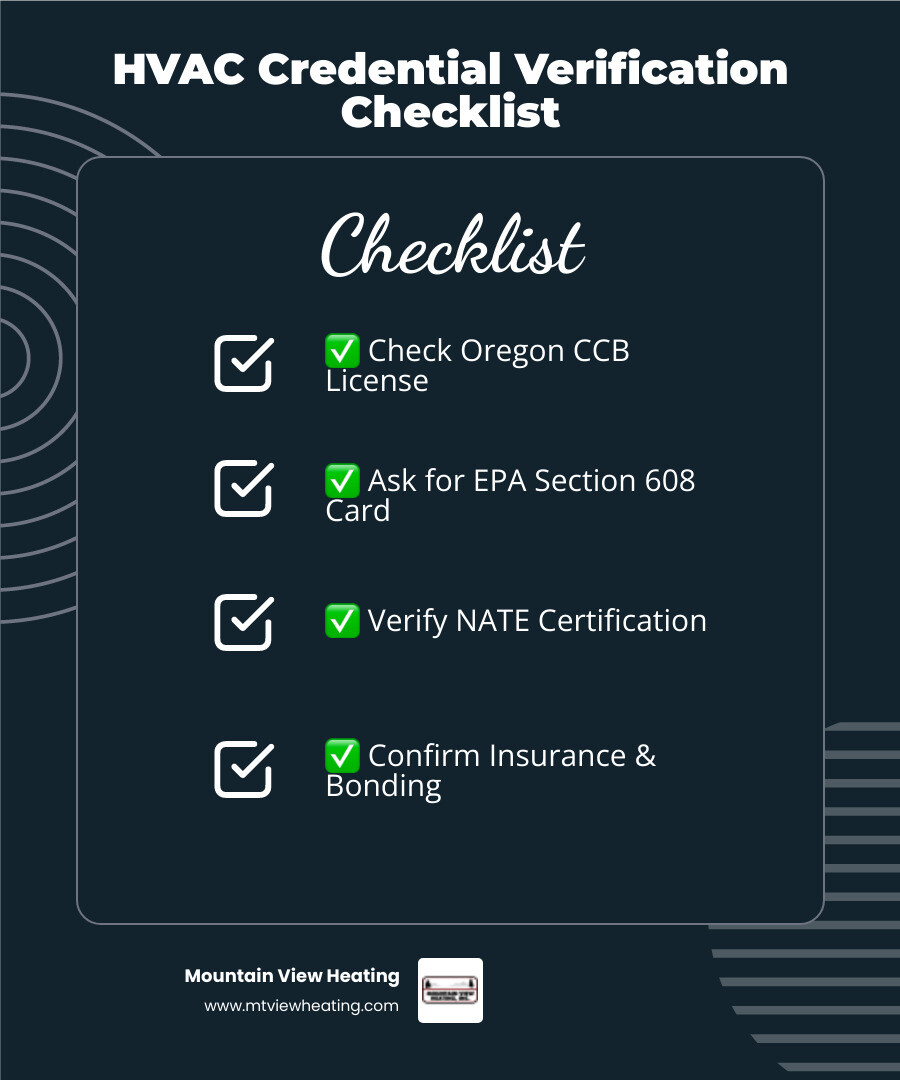
Here is a quick overview of how to verify your HVAC technician's credentials:
1. Check their Oregon CCB license — Search the Oregon Construction Contractors Board website by company name or license number to confirm active status.
2. Ask for their EPA Section 608 card — This is a federal requirement for any technician handling refrigerants. Physical cards only; digital or home-printed versions are not valid.
3. Look for NATE certification — Use the official NATE ID verification tool at natex.org to confirm the technician has passed industry-recognized exams.
4. Confirm insurance and bonding — Request proof of general liability insurance and workers' compensation coverage before work begins.
5. Check for complaints or violations — Search the Oregon CCB and review platforms like Google and the Better Business Bureau for any disciplinary history.
6. Verify manufacturer authorizations — For warranty protection, confirm the technician is trained and authorized to work on your specific equipment brand.
The stakes are real. A new HVAC system is a major component of your home, and manufacturer warranties typically require installation and service by a licensed professional. One shortcut in the hiring process can jeopardize that protection entirely.
"I want to protect my home. Why is it important to know how to verify your hvac technicians credentials in Bend?"
Living in Central Oregon means our HVAC systems are the heartbeat of our homes. From freezing January nights in La Pine to blistering August afternoons in Redmond, we rely on our furnaces and air conditioners to keep us safe. When you hire someone to service these systems, you aren't just paying for a repair; you are inviting someone to manage high-voltage electricity, pressurized refrigerants, and combustible gas lines.
If a technician is "winging it," the risks are significant:
• Safety Hazards: Improperly serviced gas furnaces can lead to carbon monoxide leaks. Since modern units use electronic ignitors, they require precise calibration that only a trained expert can provide.
• Refrigerant Leaks: Handling refrigerants requires specialized knowledge. A mistake here doesn't just hurt your cooling efficiency; it's an environmental hazard and can lead to expensive "burnouts" of your compressor.
• Electrical Fires: HVAC systems draw significant power. Faulty wiring by an uncertified individual is a leading cause of residential electrical fires.
• Financial Loss: If an unqualified person botches an installation, you could be looking at a total system failure that isn't covered by insurance or warranties.
By taking the time to learn more about professional HVAC services, you ensure that your home remains a sanctuary rather than a liability.
"What specific licenses and certifications should I look for in a Central Oregon heating expert?"
In Oregon, the barrier to entry for professional HVAC work is high for a reason. We don't just want anyone with a wrench under our floorboards. There are several layers of "proof" you should request before the work begins.
• Oregon CCB License — What It Proves: The company is legally registered, bonded, and insured in Oregon. — Who Issues It: Construction Contractors Board
• EPA Section 608 — What It Proves: Federal authorization to handle and purchase refrigerants. — Who Issues It: Environmental Protection Agency
• NATE Certification — What It Proves: High-level technical competency in installation and service. — Who Issues It: North American Technician Excellence
• Manufacturer Training — What It Proves: Specialized knowledge of specific brands (e.g., Carrier, Lennox). — Who Issues It: Equipment Manufacturers
A legitimate heating and cooling service will be proud to show you these documents. In fact, most of our technicians carry their credentials right in their service vehicles.
How to verify your hvac technicians credentials through EPA Section 608
This is the "non-negotiable" credential. Federal law requires any technician who opens a system containing refrigerant to be EPA Section 608 certified. This isn't just a local rule; it’s a requirement in all 50 states.
When you ask to see an EPA card, look for the following:
• Physical Card: The EPA does not recognize digital or home-printed certificates. It must be a physical, credit-card-sized card issued by an accredited institution.
• Certification Type: For residential work, the tech should ideally hold a "Universal" or "Type II" certification.
• Proctored Exam: Valid certifications are earned through proctored exams. If a tech mentions they took an "unproctored" online test for anything other than small appliances (Type I), it isn't valid for your home's central air or heat pump.
Using NATE and manufacturer databases to verify your hvac technicians credentials
While the EPA card is a legal requirement, NATE (North American Technician Excellence) certification is the "gold standard" for skill. Think of it like a master’s degree for HVAC. NATE-certified technicians have passed rigorous, specialized exams that test their real-world knowledge of system design and troubleshooting.
You can verify a NATE ID by visiting their official website and entering the technician's ID number. This ensures the certification is active and hasn't expired. Additionally, check for manufacturer-specific training. Many high-efficiency heat pumps and furnaces have proprietary technology. If a technician isn't factory-authorized, they might use the wrong parts, which can lead to frequent breakdowns. You can often see the difference in reviews from our customers who appreciate the precision that comes with advanced training.
"How can I tell if a technician is properly insured and bonded in Oregon?"
In Oregon, being "licensed, bonded, and insured" isn't just a catchy phrase—it's your financial safety net.
1. General Liability Insurance: This protects your home. If a technician accidentally causes a leak that ruins your hardwood floors, this insurance covers the repairs.
2. Workers’ Compensation: This is vital. If an uninsured worker is injured on your property—perhaps slipping while accessing your furnace—you as the homeowner could be held liable for their medical bills and lost wages.
3. Bonding: A surety bond acts as a guarantee that the contractor will perform the work as agreed. If they disappear halfway through a job, the bond provides a fund you can claim against to get the work finished.
To verify this in our neck of the woods, head to the Oregon Construction Contractors Board (CCB) website. You can search by the business name. A "Active" status means they have met the state's requirements for insurance and bonding. If you see "Suspended" or "Expired," do not let them start the job.
"Are there warning signs that a repair person isn't qualified for the job?"
Sometimes, a technician might have a "license" but still lack the professionalism your home deserves. Here are the red flags we tell our friends and family in Bend and Sunriver to watch out for:
• No Physical Address: If their "office" is just a cell phone number and a van, it’s hard to hold them accountable if the repair fails a week later. Our local expertise is backed by decades of physical presence in the community.
• The "Rule of Thumb" Sizing: If a tech suggests a new unit based solely on the square footage of your house without doing a "Manual J" load calculation, they are guessing. This leads to oversized systems that short-cycle or undersized systems that never get the house cool.
• Skipping Permits: In Oregon, major HVAC work requires a permit. If a contractor asks you to pull the permit yourself or says "we don't need one for this," they are likely trying to avoid a third-party inspection of their work.
• High-Pressure Tactics: If a tech tells you your furnace is a "ticking time bomb" and you must buy a new one today, get a second opinion.
• No EPA Card: As mentioned, if they can't show you their refrigerant handling card, they are breaking federal law.
"How do professional credentials protect my manufacturer warranty?"
Your HVAC system is a significant investment. Most modern systems come with a 5-to-10-year parts warranty. However, there is a major catch: the fine print.
Almost every major manufacturer (like Carrier or Lennox) stipulates that the warranty is only valid if the system is installed and maintained by a licensed professional. If you hire an uncertified "handyman" for a repair, and that repair causes a component to fail, the manufacturer can—and will—deny your warranty claim.
Furthermore, these systems require annual maintenance to keep the warranty in force. During these inspections, a qualified tech will check the ignitor, clean the coils, and ensure the system is running within factory specifications. Using factory-authorized parts is also key; "universal" parts often don't fit perfectly and can cause premature wear on other components.
To keep your system running perfectly, it's best to stick with a company that understands residential HVAC inside and out.
Frequently Asked Questions about HVAC Credentials
How do I check an Oregon HVAC license?
The best way is to visit the Oregon Construction Contractors Board (CCB) website. You can search by the company's name or their CCB license number. This tool will show you if their license is active, if they have the required insurance and bonds, and if there are any recent claims or disciplinary actions against them.
Is NATE certification mandatory for all technicians?
No, NATE certification is voluntary. However, because it requires passing difficult exams and committing to continuing education, it is the best indicator that a technician is a true professional. In a field that changes as fast as HVAC technology does, NATE certification shows a commitment to staying current.
What should I do if a technician cannot show their EPA card?
If the job involves checking refrigerant levels or repairing a leak, and the technician cannot produce a physical EPA Section 608 card, you should politely ask them to stop working. Allowing an uncertified person to handle refrigerants can lead to system damage and potential legal issues for the contractor.
Conclusion
At the end of the day, how to verify your hvac technicians credentials comes down to doing a little bit of homework to protect your biggest investment—your home. In our unique Central Oregon climate, where the high desert air and extreme temperature swings put extra stress on our equipment, you can't afford to hire someone who is just winging it.
With over 40 years of experience serving Bend, Redmond, Sisters, and beyond, we have seen exactly what happens when shortcuts are taken. That’s why we prioritize 100% customer satisfaction and ensure every member of our team is fully credentialed and ready for any challenge. Whether it's a midnight furnace failure or a routine AC tune-up, we are here for you with 24/7 emergency support.
If you need a team you can trust, reach out to your local HVAC Company in Redmond, OR or any of our other Central Oregon locations today. We’ll make sure your home stays comfortable, safe, and efficient all year long.