


Is Your AC Failing, or Just Suffocating?
With the August late-summer heat pushing temperatures to their absolute peak, you might be wondering exactly how overgrown August landscaping chokes your outdoor AC unit—especially when your system starts running constantly without actually cooling your house. It is the hottest part of the year, and hearing your outdoor equipment strain while your indoor vents blow lukewarm air is enough to make any homeowner panic. Most people immediately brace for a massive, expensive mechanical failure just as the kids are heading back to school and the end of the cooling season approaches. They assume the compressor is dead, the motor has burned out, or the entire system needs to be replaced right when they need it most.
If you are struggling to keep your home comfortable, ensuring your air conditioning systems are clear of debris is the first step, while scheduling preventative AC maintenance provides long-term peace of mind.
Here is the surprising reality our technicians at Mountain View Heating see time and time again: the system often isn't broken at all. Instead, it is simply suffocating. Over the course of the spring and summer, weeds, tall grasses, and decorative shrubs grow rapidly. By the time late summer arrives, that vegetation has completely swallowed the outdoor unit. When your air conditioner cannot pull in enough fresh air to cool the refrigerant, it loses its ability to cool your home. The decision point for you as a homeowner is knowing whether simply clearing a two-foot radius around the equipment will solve the issue, or if the restricted airflow has already caused the compressor to overheat and require professional diagnostics.
The Psychological Toll of End-of-Season Breakdowns
Nobody wants to deal with an HVAC emergency in late summer. The fear of a major repair bill often causes homeowners to ignore early warning signs, hoping the system will just limp along until autumn arrives. However, our team always warns that ignoring a suffocating unit is the fastest way to turn a minor landscaping issue into a major mechanical failure.
• The false alarm: You assume the worst when the house stays at 78 degrees despite the thermostat being set to 70.
• The easy fix: You walk outside and realize a massive bush has grown directly into the metal fins of your condenser.
• The real danger: Letting the system run while suffocated, which forces the internal components to work twice as hard to achieve half the results.
Before you assume your system has reached the end of its lifespan, take a walk outside. The solution to your August late-summer heat woes might just be a pair of pruning shears and ten minutes of yard work.
The Mechanics of Airflow: How Your Condenser Breathes
To understand why our crew emphasizes keeping weeds away from your home's comfort system, you have to understand the primary job of the outdoor unit. Your air conditioner does not actually "create" cold air. Instead, it acts as a heat transfer machine. It absorbs the thermal energy from inside your home and pumps it outside. The large metal box sitting in your yard—known as the condenser—is strictly responsible for exhausting that trapped heat into the outdoor air.
Inside that metal cabinet is a large fan and a series of delicate metallic fins wrapped around copper coils. As hot refrigerant flows from your house into those outdoor coils, the fan spins up. It pulls ambient outdoor air through the metal fins, washing that air over the hot coils to cool the refrigerant down before sending it back inside. This process requires a massive, uninterrupted volume of airflow to function correctly.
The Anatomy of Heat Transfer
When physical barriers like dense foliage, tall grass, or thick weeds block the sides of the unit, they choke off that critical air supply. Think of it like trying to run a marathon while breathing through a narrow plastic straw. The system is still trying to do the work, but it simply cannot get the oxygen it needs to function.
• Clear Perimeter — Airflow Status: Unrestricted air pulled through fins — System Impact: Optimal heat exhaust, lower energy bills, normal cycle times.
• Partial Overgrowth — Airflow Status: Airflow reduced by 30-50% — System Impact: Longer cooling cycles, warmer indoor temperatures, increased utility costs.
• Severe Blockage — Airflow Status: Airflow severely restricted or stopped — System Impact: Trapped thermal energy, overheating compressor, potential system shutdown.
When the heat cannot escape, the thermal energy remains trapped in the system. The refrigerant travels back inside your home still holding onto that heat, which means it cannot absorb any more warm air from your rooms. As a result, your system runs continuously, your energy efficiency plummets, and your monthly utility costs skyrocket—all because a bush is blocking the breeze.
Why Late-Summer High-Desert Weeds Are a Unique Threat
While overgrown landscaping is a problem everywhere, the specific climate of Central Oregon makes this issue particularly dangerous for HVAC equipment. In Bend OR residential areas, our technicians regularly deal with the rapid growth of hardy, drought-resistant weeds and native shrubs that hit their absolute peak in late summer. Plants like sagebrush, juniper, and invasive tall grasses thrive in the exact conditions that make us rely so heavily on our air conditioning.
In our decades of serving this community, the Mountain View Heating team has developed deep local experience diagnosing airflow issues that are entirely unique to Central Oregon's late-summer growth and dust. We constantly respond to service calls where homeowners expect major mechanical repairs, only to find that their condenser is completely encased in native high-desert plants. The environment here creates a perfect storm for suffocating HVAC equipment.
Why Dust and Weeds Are a Toxic Combination
The real threat isn't just the leaves and branches—it is the compounding effect of our dry, dusty conditions. Throughout August, the high-desert wind kicks up incredibly fine dirt and silt. When you have overgrown vegetation pressing against your condenser, that fine dust gets trapped. It clings to the leaves, stems, and sap of the encroaching plants.
As the condenser fan tries to pull air through this messy barrier, it sucks that combination of dust and plant matter directly into the delicate metal fins. Our maintenance crews often find a thick, blanket-like barrier over the coils that acts almost like a layer of cement.
• Early Spring Conditions: Plants are small, dust is minimal due to seasonal moisture, and the AC is rarely running. Airflow remains relatively unobstructed.
• Late Summer Conditions: Vegetation is fully grown, the ground is bone dry, and the AC is running constantly. The continuous suction pulls every loose leaf and dust particle directly into the unit.
This is why an air conditioner that worked perfectly in June might suddenly struggle in August. The gradual buildup of high-desert dust mixed with aggressive weed growth creates an impenetrable wall that traps heat inside the equipment.
The 2-Foot Clearance Rule for Outdoor Cooling Units
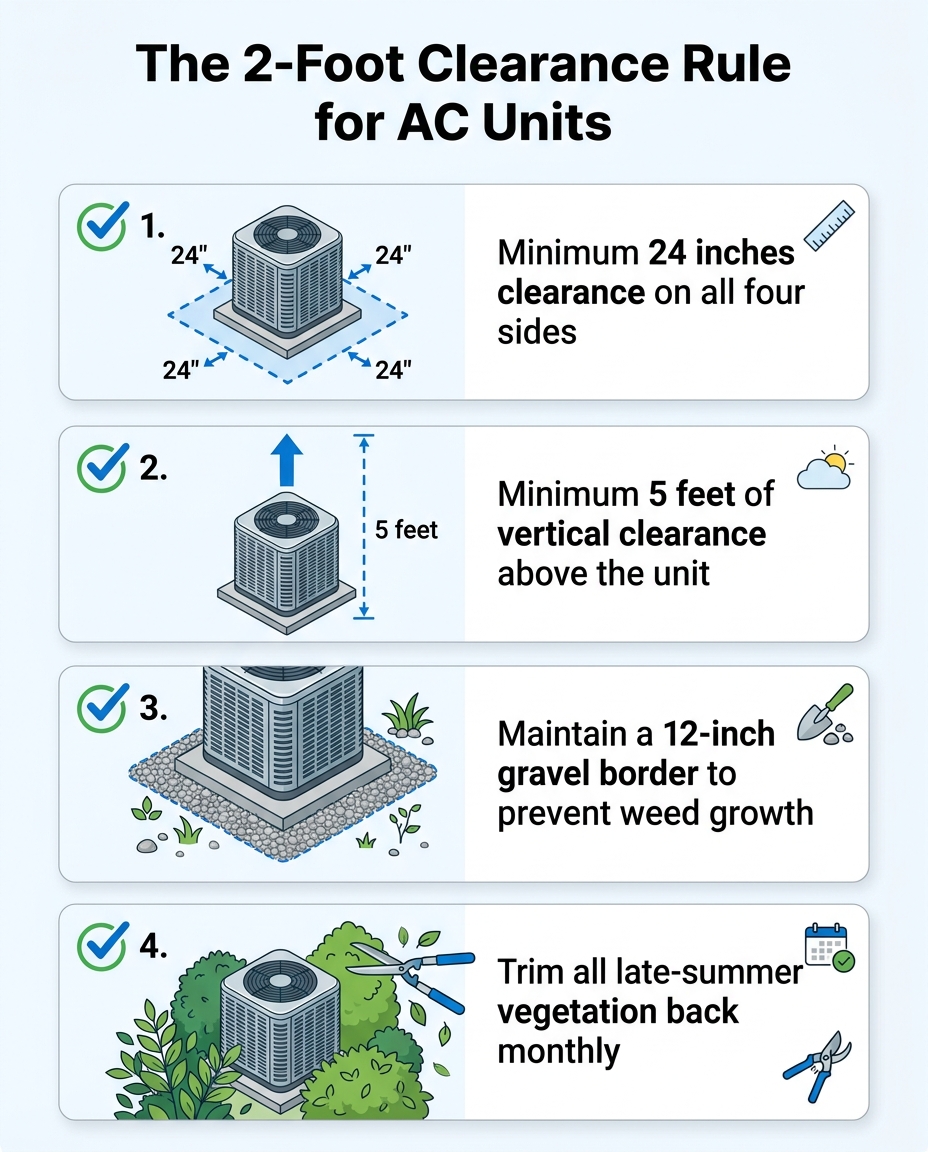
Protecting your equipment from this high-desert suffocation comes down to one simple, universal guideline that we preach on every service call: the two-foot clearance rule. Every outdoor cooling unit requires a strict minimum of 24 inches of completely unobstructed space on all four sides. This rule applies to traditional air conditioners as well as outdoor heat pump units, which operate using the exact same heat-transfer principles during the summer cooling season. (Note: Qualifying heat pump installations may also be eligible for generally applicable energy rebates or federal tax credits, so be sure to check with your utility or tax professional to verify current programs.)
This 24-inch buffer zone ensures that the fan can pull in enough ambient air from all directions to properly cool the internal coils. When you violate this rule by planting shrubs too close or letting weeds grow wild, you are actively robbing the system of its ability to breathe.
Measuring Your Clearance Zone
Maintaining the proper clearance is not a one-time job; it requires active monitoring, especially as August late-summer heat accelerates weed growth. We recommend following these numbered steps to evaluate and secure your unit's perimeter:
1. Measure the horizontal space: Take a tape measure and verify that there is at least 24 inches of empty space between the metal cabinet and any fences, walls, bushes, or tall grass.
2. Check the vertical clearance: Look directly above the unit. There must be a minimum of 5 feet of completely unobstructed space above the fan to allow the hot exhaust air to vent upward. Low-hanging tree branches or deck overhangs will force that hot air to recirculate right back into the system.
3. Trim back aggressive growth: Use pruning shears to cut back any shrubs or bushes that have encroached into the two-foot zone. Do not just trim the branches touching the unit; cut them back far enough that they won't grow back into the zone before winter.
4. Pull weeds from the root: Eliminate tall grasses and weeds growing around the base of the concrete pad. Weed-whacking is dangerous near the unit, as it flings debris directly into the delicate aluminum fins. Hand-pulling is the safest method.
5. Remove loose debris: Rake away dead leaves, fallen branches, and loose dirt from the immediate area to prevent the fan from sucking them up during its next cycle.

Warning Signs of an Overheated Compressor
Sometimes, homeowners don't realize their landscaping has choked their unit until the system starts showing signs of severe mechanical distress. When airflow is blocked for weeks at a time, the compressor—the "heart" of your air conditioning system—is forced to work harder and run longer. Eventually, this mechanical strain pushes the compressor past its limits, causing it to overheat.
If your system has been suffocating in the August late-summer heat, you need to know when the problem has escalated from a simple yard-work issue to a situation requiring professional AC repair in Bend. Catching these warning signs early can mean the difference between a simple reset and a catastrophic compressor failure.
When to Turn the System Off Completely
If you notice any of the following symptoms, stop your DIY landscaping efforts, turn the thermostat to the "OFF" position immediately, and call for professional help. Continuing to run an overheated system will cause permanent damage.
• Short cycling: The system turns on, runs for only a few minutes, and abruptly shuts off before cooling the house. This often means the compressor is overheating and tripping its internal safety switch.
• Loud humming or buzzing noises: If the outdoor unit is making an aggressive electrical buzzing sound but the fan blade isn't spinning, the motor may be burned out from trying to pull air through a solid wall of debris.
• Continuous running with no relief: The unit runs for hours on end, but the air coming from your indoor vents is lukewarm. This indicates the heat transfer process has completely failed due to blocked coils.
• Excessive heat radiating from the cabinet: While the unit is designed to exhaust heat, the metal cabinet itself should not feel dangerously hot to the touch.
Consistent preventative care is the best way to avoid these scary symptoms. For example, our technicians recently performed routine spring maintenance for a long-term customer who has been with us since 2007, tuning up their heat pump, furnace, and propane fireplace. During that visit, our team identified and resolved an emerging service issue where early vegetation growth was already beginning to restrict airflow. By addressing the landscaping and cleaning the coils early in the year, we helped them prevent a complete compressor failure before the heavy late-summer demand even began.
Safe Landscaping Practices Around HVAC Equipment
We understand that outdoor AC units are not exactly the most attractive feature of your backyard. Many homeowners in Bend OR residential areas naturally want to hide their equipment behind screens, trellises, or lush gardens. We frequently reassure our customers that you can absolutely landscape around your HVAC equipment, provided you use safe practices that prioritize airflow over aesthetics.
The key is choosing the right materials and the right plants, while always respecting the mandatory two-foot clearance zone. A well-planned landscaping design can actually help your system by providing shade, which keeps the ambient air around the condenser slightly cooler, as long as the airflow remains unobstructed.
Creating a Defensible Space for Your Equipment
To keep your cooling system safe from late-summer overgrowth, you need to establish a defensible perimeter around the concrete pad. Here is how our experts recommend creating an HVAC-friendly landscape:
• Install a gravel border: Dig out the grass and dirt immediately surrounding the unit's concrete pad and replace it with a 12-inch to 24-inch border of crushed rock or heavy gravel. This prevents weeds from sprouting right against the unit and dramatically reduces the amount of loose dust the fan can suck up.
• Choose HVAC-safe plants: If you want to plant shrubs outside the two-foot zone, choose varieties that do not shed excessive leaves, seeds, or fine debris. Avoid cottonwoods, heavy seeding grasses, or plants that lose their foliage in the wind. Opt for low-growing succulents or sturdy, slow-growing evergreen shrubs.
• Use breathable screening: If you prefer to hide the unit with a physical barrier, use a lattice screen or a fence with wide slats. Solid fences block airflow completely. Ensure the screen is placed at least 24 inches away from the unit, and leave one side completely open so service technicians can access the equipment for maintenance.
• Schedule end-of-summer visual inspections: Make it a habit to walk the perimeter of your house every August. Visual inspections are your best defense against aggressive late-summer weed growth.
Keep Your Cooling System Breathing Easy This August
As the August late-summer heat continues to bear down on Central Oregon and families prepare for the back-to-school transition, your air conditioner needs every advantage it can get to keep your family comfortable. Clearing away overgrown vegetation, pulling tall weeds, and ensuring your condenser has a full two feet of breathing room is the absolute easiest, most cost-effective way to protect your system's efficiency during the hottest part of the year.
Always remember to check your clearances before assuming the worst about a struggling AC unit. A suffocating system mimics the symptoms of a dying system, but restoring that critical airflow often resolves the issue instantly. If you have cleared the perimeter, removed the debris, and your system is still running constantly without dropping the indoor temperature, it is time to seek professional help from the Mountain View Heating team. Do not let an overheated compressor ruin the end of your summer—explore professional tune-up options to get your cooling power back on track.
Frequently Asked Questions
How much clearance does an outdoor AC unit need?
An outdoor AC unit requires a minimum of 24 inches of clearance on all four sides. Additionally, it needs at least 5 feet of completely unobstructed vertical space above the fan to exhaust hot air properly. Maintaining this space ensures the system can pull in enough ambient air to cool the internal coils without straining the compressor.
Can overgrown plants damage my air conditioner?
Yes, overgrown plants can cause severe mechanical damage to your air conditioner. When foliage blocks the metal fins, the system cannot exhaust trapped heat, which forces the compressor to work twice as hard. Over time, this extreme mechanical strain can cause the compressor to overheat and fail prematurely.
What happens if AC condenser airflow is blocked?
If the AC condenser airflow is blocked, the heat absorbed from inside your home cannot be released outside. The thermal energy remains trapped in the refrigerant, meaning the system can no longer produce cold air. This leads to continuous running, skyrocketing energy bills, and eventual overheating of the internal components.
Why is my AC running but not cooling in summer?
When an AC runs continuously without cooling, it usually means the heat transfer process has been interrupted. In late summer, this is very frequently caused by overgrown landscaping suffocating the outdoor unit, preventing it from exhausting heat. It can also indicate a dirty indoor filter, frozen evaporator coils, or an overheated compressor shutting down to protect itself.
How can I safely hide my outdoor AC unit with plants?
You can safely hide your AC unit by planting slow-growing, low-debris shrubs strictly outside the mandatory two-foot clearance zone. Avoid plants that shed heavy leaves, seeds, or fluff that could get sucked into the condenser fins. Alternatively, use a breathable lattice screen placed at least 24 inches away from the cabinet to obscure the view while maintaining airflow.
Can dust and dirt from my yard cause my AC to overheat?
Absolutely, fine dust and dirt are major contributors to AC overheating. When dry yard dust mixes with overgrown vegetation around the unit, the condenser fan sucks that debris directly into the delicate metal fins. This creates a thick, cement-like barrier that blocks airflow, traps heat, and forces the system to work significantly harder.