


The Myth of Maximum Filtration: Why More Isn't Always Better
Choosing the right MERV rating for winter indoor air quality does not mean automatically grabbing the filter with the highest number printed on the box, even though big-box retail marketing often suggests otherwise. At Mountain View Heating, a pattern we see often is the misconception among homeowners that installing a hospital-grade, highly restrictive filter is the best way to protect their family from winter viruses and airborne dust. However, this well-intentioned choice often introduces a concrete mechanical problem: installing a highly restrictive MERV 13 or higher filter can severely choke a standard residential furnace blower, starving the entire heating system of necessary return air.
The real decision point lies in finding the exact filtration rating that improves the air you breathe without causing premature mechanical failure to your heating equipment. Because September pre-heating season prep is the critical window to make this decision, understanding how your furnace actually interacts with these filters is essential before the first hard freeze arrives.
If you are looking to improve your indoor air quality without causing mechanical damage, scheduling a professional furnace tune up is the safest place to start.
The Big-Box Retail Marketing Trap
Retail filter packaging is designed to sell peace of mind. You will often see high-MERV filters labeled with terms like "maximum allergen defense" or "virus blocker." While these claims about the filter media itself are generally true, the marketing completely ignores the mechanical reality of the furnace sitting in your garage or crawlspace. Your heating system was engineered to move a specific volume of air per minute. When you place a dense, restrictive barrier in front of that blower motor, you force the system to work exponentially harder to pull the same amount of air. In our years of servicing heating equipment in Bend, we've found that most standard residential furnaces simply do not have the blower capacity to overcome that level of resistance without suffering long-term consequences.
Understanding the Mechanical Reality of Airflow Resistance
To make an informed decision, you first need to understand what the MERV rating actually measures. MERV stands for Minimum Efficiency Reporting Value. This rating scale, developed by the American Society of Heating, Refrigerating and Air-Conditioning Engineers (ASHRAE), grades a filter's ability to capture particulates ranging from 0.3 to 10 microns in size. The higher the MERV rating, the tighter the weave of the filter media, and the smaller the particles it can trap.
However, there is a strict mechanical trade-off. Tighter weaves catch smaller particles, but they require significantly more force to push air through. This resistance is known in the HVAC industry as static pressure. When comparing the MERV 8 to MERV 13 airflow resistance differences, the jump in static pressure is dramatic. A standard MERV 8 filter allows air to flow freely while catching common household dust and pollen. A MERV 13 filter, designed to catch bacteria and droplet nuclei, acts almost like a solid wall to a standard residential blower motor.
The Limits of Standard Residential Blowers
Standard residential blower motors are simply not designed for commercial-grade static pressure. Commercial HVAC systems in hospitals or large office buildings—which regularly use MERV 13 or higher filters—are equipped with heavy-duty, variable-speed blowers specifically engineered to push through dense media. When you put that same dense media into a standard home furnace, the blower motor has to strain against the resistance. Our team frequently replaces blower motors that have been pushed past their designed static pressure limit, which leads to overheating, excessive energy consumption, and premature wear on the motor's bearings and electrical components. The motor works harder, runs hotter, and ultimately fails faster, all while delivering less warm air into your living spaces.
How Restrictive Filters Can Suffocate Your Furnace
When a furnace is starved of return air due to a highly restrictive filter, a specific sequence of mechanical failures begins to unfold inside the cabinet. The problem starts at the return drop, where the blower motor struggles to pull enough air through the dense filter media. Because less air is entering the system, less air is moving over the heat exchanger.
The cause of the subsequent failure is heat buildup. The heat exchanger is a series of metal tubes or coils that get incredibly hot when the furnace burners ignite. In a healthy system, the blower pushes a high volume of indoor air over this hot metal, stripping the heat away and carrying it into your ductwork. When airflow is severely restricted, that heat cannot be pushed into the home's air distribution network. Instead, the heat remains trapped inside the furnace cabinet, causing the internal temperature to spike rapidly.
The solution—or rather, the system's emergency response—is triggered by a safety mechanism called the high-limit switch. This sensor monitors the temperature inside the furnace cabinet. If the temperature exceeds a safe threshold, the high-limit switch immediately shuts off the gas burners to prevent a catastrophic fire hazard or a cracked heat exchanger. Once the cabinet cools down, the furnace tries to run again, only to overheat and shut down moments later. This rapid on-and-off cycle is known as "short-cycling," and it is the most common direct symptom of a suffocated furnace.
The Chain Reaction of Overheating
Understanding this sequence highlights exactly why high-filtration filters can be so damaging. The chain reaction looks like this:
• Airflow drops: The dense filter prevents the blower from pulling enough return air into the cabinet.
• Heat exchanger temperature spikes: Without enough air moving over the metal to absorb the heat, the internal temperature rises to dangerous levels.
• Safety limit switch trips: The internal sensor detects the excessive heat and cuts power to the burners to prevent a fire.
• System shuts down before the house is warm: The thermostat never reaches its set temperature, leaving your home cold while the furnace repeatedly starts and stops.
The Danger of Short-Cycling During Freezing High Desert Nights
In a mild, temperate climate, a short-cycling furnace might just be a frustrating annoyance that drives up your energy bill. However, as our technicians know from years of working in the Central Oregon / Bend climate, a failing furnace is a serious freezing hazard. Our region is characterized by high desert winters where daytime temperatures might feel manageable, but nighttime temperatures routinely plummet well below freezing. These rapid temperature drops overnight demand consistent, uninterrupted heating cycles to keep the home safe and habitable.
When a furnace is short-cycling due to a restrictive filter, it cannot run long enough to thoroughly warm the home. More importantly, repeated high-limit switch trips will eventually cause the furnace's control board to initiate a "hard lockout." A hard lockout completely disables the furnace, requiring a manual reset or a professional service call to restore functionality. This safety feature exists to protect the equipment from destroying itself, but it leaves the home completely without heat when it is needed most.
Maintaining Even Temperatures During Cold Snaps
Proper air distribution is essential for maintaining even temperatures across the home during severe cold snaps. When airflow is choked at the filter, the rooms furthest from the furnace will likely never receive enough warm air, leading to freezing pipes and deeply uncomfortable living spaces. Emphasizing reliable heating as a safety necessity, rather than just a comfort preference, is why our team at Mountain View Heating strongly advises against risking your equipment's reliability for a slight bump in filtration ratings during the winter months.
Comparing Filter Ranges: Finding the Sweet Spot for Residential HVAC
To balance the need for clean indoor air with the mechanical requirements of your heating system, it helps to see how different filter ranges compare. Finding the sweet spot means selecting a filter that captures the most common household irritants without putting dangerous levels of static pressure on your blower motor.
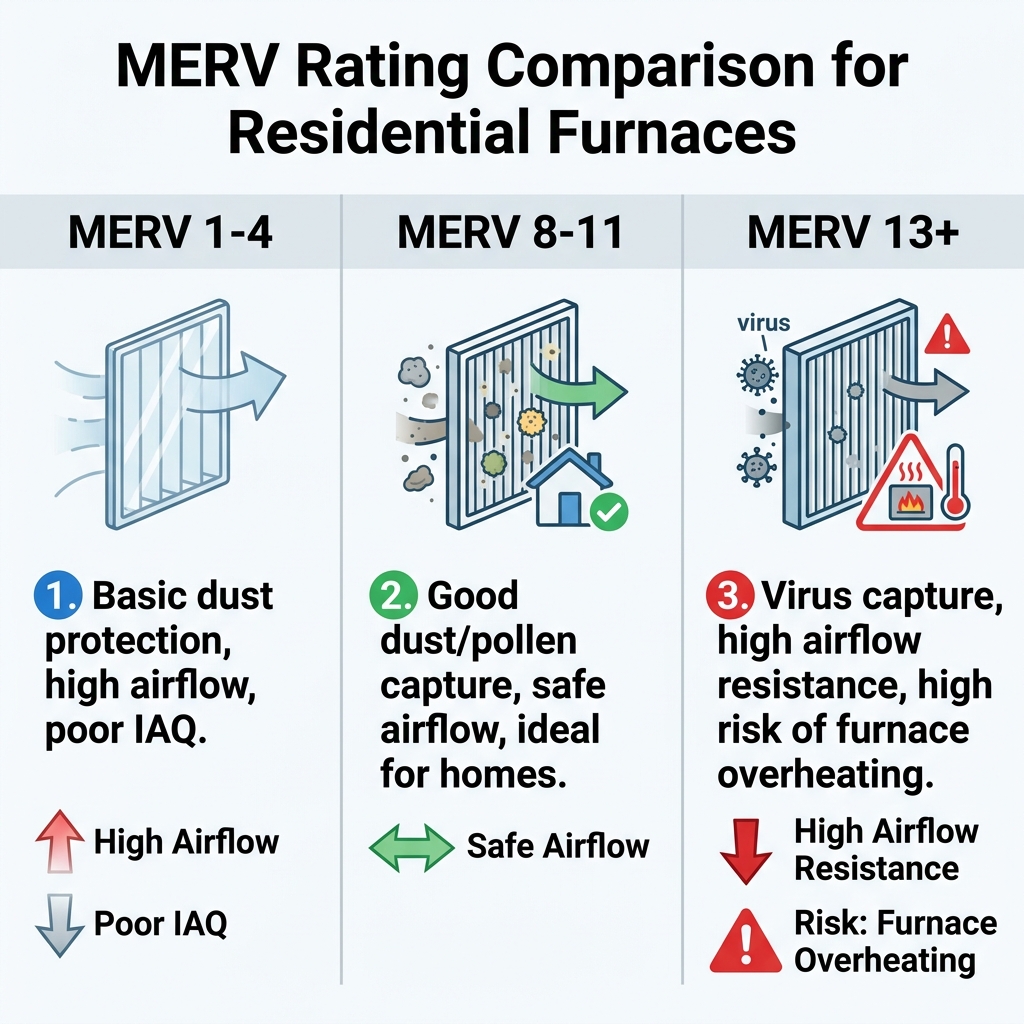
• MERV 1-4 — Primary Capture Targets: Large dust particles, lint, insects — Airflow Resistance (Static Pressure): Very Low — Impact on Residential Furnace Safety: Safe for equipment, but offers negligible indoor air quality benefits for the home's occupants.
• MERV 8-11 — Primary Capture Targets: Dust mites, pollen, pet dander, mold spores — Airflow Resistance (Static Pressure): Moderate — Impact on Residential Furnace Safety: The ideal sweet spot. Captures majority of household allergens while maintaining safe airflow levels for standard blowers.
• MERV 13+ — Primary Capture Targets: Bacteria, droplet nuclei, fine smoke — Airflow Resistance (Static Pressure): Very High — Impact on Residential Furnace Safety: High risk. Acts as a wall to airflow, frequently causing overheating, short-cycling, and premature motor failure in standard systems.
We typically recommend that homeowners prioritize the MERV 8 to 11 range for winter heating. This range provides excellent filtration for the vast majority of household needs, pulling dust, pollen, and pet dander out of circulation. Unless your specific HVAC system was custom-designed, duct-modified, and balanced by a professional to handle the high static pressure of commercial-grade filters, staying in the 8 to 11 range is the most effective way to protect both your lungs and your furnace.

Achieving Healthy Air Without Sacrificing Equipment Safety
It is entirely valid to want the cleanest air possible inside your home, especially in a dusty high-desert environment where allergens are frequently tracked indoors. However, trying to achieve hospital-grade air quality solely through your furnace's 1-inch return filter is the wrong approach. There are highly effective alternative solutions for homeowners who want maximum protection against viruses and fine dust without breaking their heating equipment.
The most effective strategy is to decouple your air purification from your heating process. Dedicated, standalone air purification systems operate independently of the central furnace blower. These systems, whether they are whole-home units installed in the ductwork with their own bypass fans or portable HEPA units placed in high-traffic rooms, handle the heavy lifting of scrubbing the air. This allows the furnace to focus solely on its primary job: efficient heating without airflow bottlenecks.
The Role of Winter Humidity in Air Quality
Another critical factor in winter indoor air quality is managing indoor moisture. Dry winter air holds dust and allergens in suspension much longer than properly humidified air. Furthermore, dry air feels colder against the skin, prompting homeowners to turn up the thermostat and force the furnace to run longer. Proper humidity control naturally reduces airborne dust by causing particles to clump together and fall out of the breathing zone, while also making the ambient air feel significantly warmer.
Our team sees the benefits of this balance firsthand. During a routine winter heating and air conditioning system servicing here in Bend, one of our technicians quickly identified and repaired a significant problem with a local homeowner's humidifier. Getting that humidifier back online not only resolved the issue and exceeded expectations, but it dramatically improved how comfortable the indoor air felt, reducing airborne irritants without ever requiring a denser, restrictive furnace filter. Balancing these secondary systems is the true secret to healthy winter air.
A Strategic Approach to Fall Filter Replacement
Preparing your home for the cold months requires more than just turning the thermostat from "cool" to "heat." Establishing a strategic routine during your September pre-heating season prep will ensure your system is ready to handle the heavy workload ahead.
1. Audit and swap out summer filters: If you used a higher-rated filter during the summer to combat wildfire smoke (when the AC is running and furnace overheating isn't a risk), remove it before the first hard freeze hits. Transition back to a heating-safe filter.
2. Stock up on the right ratings: Purchase a multi-pack of high-quality pleated filters in the MERV 8 or 11 range. Having them on hand makes it much easier to stick to a replacement schedule.
3. Establish a monthly check routine: During peak heating months, pull the filter out once every 30 days. Hold it up to a light source; if you cannot see light shining through the media, it is time to replace it, regardless of whether it has been a full month.
4. Assess secondary purification needs: If you find yourself constantly wanting a higher MERV rating due to allergies, research whether are air purifiers actually effective for your specific household needs, rather than taxing your furnace.
5. Schedule static pressure testing: If you insist on using high-MERV filters for health reasons, have a professional assess your system's static pressure to ensure your ductwork and blower can actually handle the load.
Working with a local expert who understands our team's deep expertise at Mountain View Heating in balancing indoor air quality with optimal furnace performance specifically for Central Oregon homes ensures you never have to guess about your system's safety.
Keep Your Home Warm and Breathing Easy This Winter
Ultimately, the right furnace filter does two things simultaneously: it protects the air your family breathes, and it protects the mechanical equipment keeping you warm. Sacrificing your furnace's airflow for extreme filtration is a dangerous trade-off that often leads to short-cycling, sudden breakdowns, and freezing nights without heat.
By staying within the recommended MERV 8 to 11 range, you allow your heating system to operate exactly as the manufacturer intended. If you are unsure whether your current filter is choking your system, or if you want to explore safer ways to improve your indoor air quality, scheduling professional maintenance is the best next step. A thorough tune-up ensures your blower motor is healthy, your static pressure is balanced, and your home is fully prepared for the winter ahead.
Frequently Asked Questions
Can too high a MERV rating damage my furnace?
Yes, using a filter with too high a MERV rating can cause significant damage to your furnace. High-MERV filters restrict the amount of air the blower motor can pull into the system, causing the heat exchanger to overheat. Over time, this extreme heat and restricted airflow can lead to a cracked heat exchanger, a burnt-out blower motor, and frequent system shutdowns.
What is the best MERV rating for a residential furnace in winter?
We generally recommend a MERV rating between MERV 8 and MERV 11 for most standard residential furnaces during the winter. This range provides a perfect balance, capturing common household allergens like dust mites, pollen, and pet dander without creating dangerous levels of airflow resistance. Filters in this range keep the air clean while allowing the furnace to heat the home efficiently.
Does MERV 13 restrict airflow too much?
For the vast majority of standard residential HVAC systems, a MERV 13 filter restricts airflow far too much. These filters are primarily designed for commercial systems or custom-built residential systems with heavy-duty, variable-speed blowers. Putting a MERV 13 filter in a standard home furnace acts like a wall, forcing the motor to strain and often triggering the high-limit safety switch due to overheating.
Is a higher MERV rating always better for allergies?
While a higher MERV rating traps smaller allergy-causing particles, it is not always the best overall solution for your home. If the filter is so dense that it suffocates the furnace, the system won't be able to circulate air effectively, meaning those allergens remain stagnant in your living spaces anyway. A better approach for severe allergies is using a moderate MERV 8-11 filter combined with a dedicated standalone air purifier.
How often should I change a MERV 8 filter during the heating season?
During the peak winter heating season, you should check your MERV 8 filter every 30 days and expect to replace it every 1 to 3 months. In homes with multiple pets, high dust levels, or frequent furnace usage during extreme cold snaps, the filter will clog much faster. A good rule of thumb is to hold the filter up to a light; if no light passes through, it must be replaced.
What are the signs that my furnace filter is suffocating my blower?
The most obvious sign of a suffocated blower is short-cycling, where the furnace turns on, runs for only a few minutes, and shuts off before the house is warm. You might also notice a whistling sound near the return vent, unusually weak airflow coming from your supply registers, or the furnace cabinet feeling excessively hot to the touch. If you experience these symptoms, turn off the system and check the filter immediately.