

The September Chill: Before You Turn on Your Aging Gas Furnace
The September chill is settling over Central Oregon, and while the temptation to simply flip the thermostat to "heat" is strong, understanding exactly why carbon monoxide checks are non-negotiable for aging gas furnaces is the most critical step you can take for your family's safety. Before the first hard freeze arrives, many homeowners make the mistake of performing a blind startup. They assume that because the system ran fine last winter, it will run safely again this year. However, aging equipment develops microscopic flaws during the off-season that are completely invisible to the naked eye.
If you need reliable heating services or comprehensive furnace repair, reaching out to a professional before the temperatures plummet is the safest first step.
The Reality of the Blind Startup
During the September pre-heating season transition, your furnace has been sitting idle for months. Dust has settled on the burners, and more importantly, the internal metal components have been resting in a contracted state. When you suddenly demand high heat, you are stressing a system that has already endured years of wear and tear. A blind startup means you are trusting a decade-old piece of metal to safely contain dangerous combustion gases without any verification.
Choosing a verified safety inspection over a blind startup is not just about avoiding a breakdown; it is a structural safety necessity. Carbon monoxide checks are often misunderstood as an optional upsell during routine maintenance. In reality, they are the only way to confirm that the vital barrier between the fire in your furnace and the air circulating through your home remains entirely intact.
• Blind Startup — Immediate Result: System turns on, blows warm air. — Long-Term Safety Impact: Zero verification of structural integrity; high risk of undetected gas leaks.
• Basic Filter Change — Immediate Result: Improved airflow and efficiency. — Long-Term Safety Impact: Does not detect internal metal fatigue or combustion issues.
• Verified CO Check — Immediate Result: Confirmation of safe combustion. — Long-Term Safety Impact: Total peace of mind; confirms the heat exchanger is structurally sound.
As we transition into the colder months, making the choice to verify your system's structural integrity is the only way to ensure the warm air filling your home is completely safe to breathe.
The Physics of Thermal Expansion in Central Oregon Winters
To understand why aging systems become risky, we have to look at the physics of how a gas furnace actually works. The heart of your heating system is a component called the heat exchanger. This is a series of metal tubes or coils where the actual combustion takes place. When the gas burners ignite, the flames heat up the metal of the heat exchanger. Your blower motor then pushes air over this hot metal, warming the air before it travels through your ductwork. The critical factor here is that the combustion gases inside the heat exchanger must never mix with the breathing air blowing over the outside of it.
The Constant Cycle of Expansion and Contraction
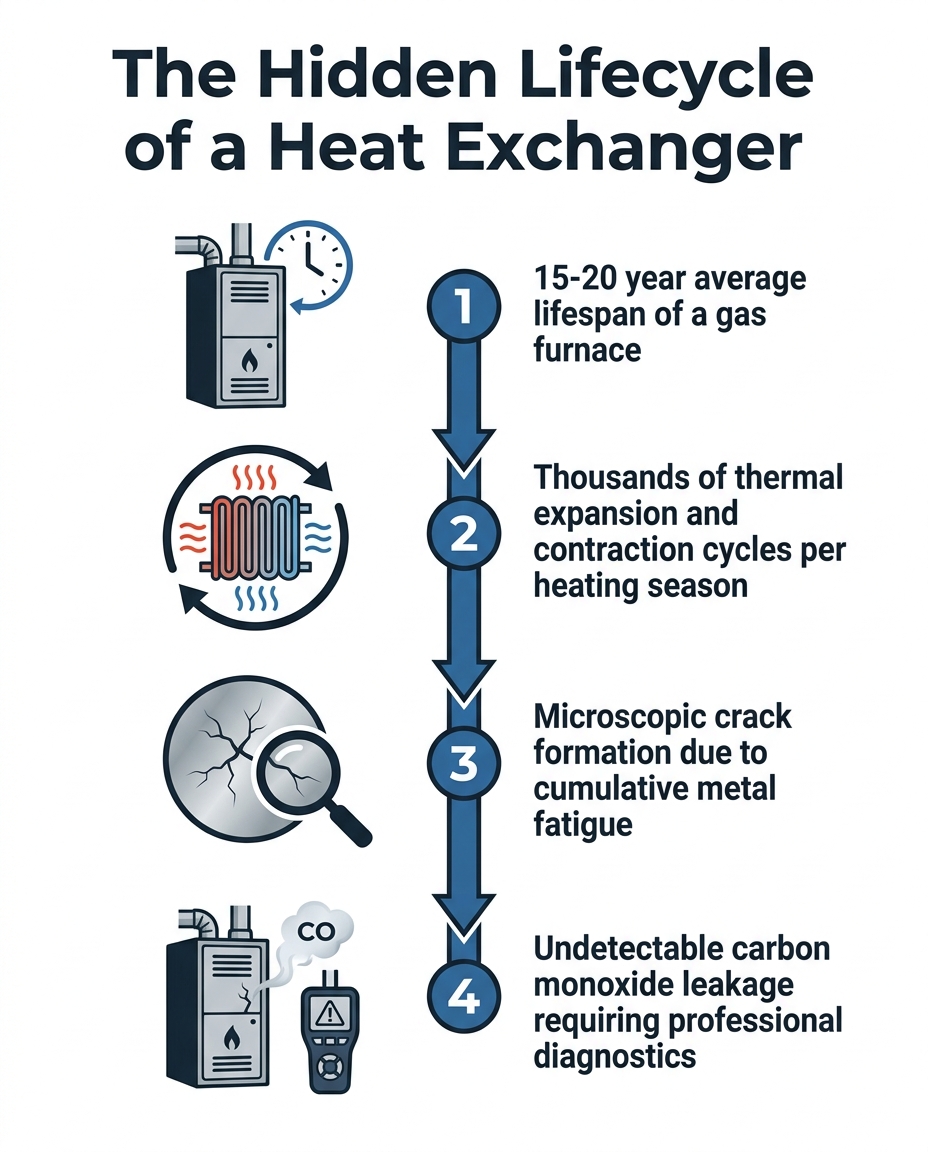
Bend's high desert climate and freezing winter temperatures force gas furnaces into prolonged, heavy heating cycles. When metal gets hot, it expands. When the thermostat is satisfied and the burners shut off, the metal cools and contracts. This process is known as thermal expansion. In Central Oregon, a furnace might go through this intense heating and cooling cycle dozens of times a day, every single day, from late fall through early spring.
Over the first few years of a furnace's life, the metal easily handles this stress. But as the system ages, this constant expansion and contraction leads to cumulative metal fatigue. The metal becomes brittle. What starts as microscopic stress points eventually turns into hairline cracks. Because these cracks only open up when the metal is fully heated and expanded, they are often impossible to see when the furnace is turned off and the metal has contracted.
How Metal Fatigue Compromises Your System
Metal fatigue in a 10+ year old furnace is a serious structural issue. The heat exchanger is the absolute only barrier separating toxic combustion gases from the air you and your family breathe. When metal fatigue compromises this barrier, the structural integrity of the entire heating system fails.
• Microscopic stress fractures: These form along the seams and curves of the heat exchanger where the metal flexes the most.
• Expansion under pressure: The cracks widen only when the furnace is running at peak temperature.
• Forced air interference: The blower motor creates pressure that can push or pull gases through these tiny openings.
Because these flaws develop deep inside the cabinet of the furnace, homeowners cannot simply open a panel and spot the danger. The wear and tear accelerated by Bend's harsh winters requires specialized knowledge to diagnose properly.

Microscopic Cracks and the Invisible Threat of Carbon Monoxide
The most terrifying aspect of a cracked heat exchanger is the specific nature of the gas it releases. Carbon monoxide (CO) is a completely colorless, odorless, and tasteless gas. It is a natural byproduct of burning fossil fuels, including natural gas and propane. Under normal, safe operating conditions, your furnace vents this gas safely out of your home through the flue pipe. But when a heat exchanger fails, the rules change entirely.
How the Gas Escapes
When the heat exchanger cracks, the pressurized air from your furnace's blower motor interacts with the combustion chamber. This pressure imbalance can push carbon monoxide directly into the home's ventilation system. From there, the ductwork distributes the toxic gas into every room of the house. This is one of the most severe hidden dangers of delaying fall heating maintenance. Because you cannot see or smell the gas, a family in Bend, OR or anywhere in Central Oregon could be exposed to rising CO levels without any immediate warning signs.
Debunking Dangerous Myths
There is a persistent myth that you can "smell" a carbon monoxide leak. You cannot. If you smell a rotten egg odor, that is a natural gas leak—a different, though equally serious, problem. Another common myth is that as long as the furnace burner flame is blue, the system is safe. While a yellow flame does indicate incomplete combustion and higher CO production, a perfectly blue flame can still produce enough carbon monoxide to be harmful if the heat exchanger is cracked and venting into the living space.
According to data from the Centers for Disease Control and Prevention (CDC) and the Consumer Product Safety Commission (CPSC), undetected carbon monoxide exposure is a leading cause of accidental poisoning in the home. The symptoms of low-level exposure—headaches, dizziness, nausea, and fatigue—are easily mistaken for the common cold or winter flu. Relying on physical symptoms to detect a structural failure in your furnace is incredibly dangerous. Proactive detection is the only reliable defense.
Cumulative Metal Fatigue: When Your Furnace Reaches the Decade Mark
Age is the single biggest risk factor for heat exchanger failure. The typical lifespan of a well-maintained gas furnace is 15 to 20 years. However, the risk of structural failure does not increase linearly; it increases exponentially once the system passes the 10-year mark. During the first decade, the metal is resilient. After a decade of enduring the September pre-heating season transition through the freezing depths of winter, the cumulative metal fatigue takes a permanent toll.
The Vulnerability of Older Equipment
Older units often lack some of the advanced diagnostic fail-safes found in ultra-modern systems. While all furnaces have limit switches designed to shut the system down if it overheats, an older furnace cannot sense a microscopic hairline crack in its own heat exchanger. It will continue to run, burn gas, and distribute air, completely unaware that it is leaking combustion byproducts into the airstream.
This is exactly why aging equipment requires a much different level of diagnostic care than a brand-new system. A basic furnace tune-up on a new unit focuses primarily on efficiency and calibration. On a 12-year-old unit, the primary focus must shift to structural safety and metal fatigue analysis.
Proactive Scheduling Prevents Emergencies
A typical pattern we see involves proactive scheduling even under tight constraints. For example, during a recent winter, a homeowner with a vacation property needed HVAC maintenance and a propane fireplace repair on a very narrow timeline. Because they prioritized this service despite limited availability, the technician was able to thoroughly clean and repair the systems, verifying that no hidden metal fatigue or venting issues threatened the home while it was unoccupied. Catching these issues during routine maintenance before an emergency occurs is always the preferred outcome.
Beyond the Basics: How Certified Professionals Detect Hidden Flaws
Because carbon monoxide is invisible and microscopic cracks often close up when the metal cools, detecting these flaws requires advanced technology and specialized training. A standard visual once-over with a flashlight is entirely insufficient for an aging gas furnace. Mountain View Heating's rigorous, certified inspection protocols detect microscopic structural flaws before they become dangerous, prioritizing your family's health over quick fixes.
Here is how certified professionals uncover the hidden dangers in your heating system:
1. Ambient Carbon Monoxide Baseline Testing: Before even opening the furnace cabinet, technicians use highly sensitive detectors to measure the baseline CO levels in the ambient air of your home. This establishes whether low-level leakage is already occurring in Bend, OR and Central Oregon homes.
2. Flue Gas Combustion Analysis: Professionals insert a calibrated combustion analyzer directly into the exhaust flue. This tool measures the exact chemical composition of the exhaust gases. If the oxygen and carbon monoxide levels fluctuate erratically when the blower motor turns on, it strongly indicates a breach in the heat exchanger.
3. High-Definition Visual Inspection: Technicians use specialized, flexible inspection cameras (borescopes) to snake deep into the heat exchanger cells. This allows them to see the back sides and narrow curves of the metal where stress fractures typically begin, areas that are otherwise completely hidden from view.
4. Draft and Venting Verification: The inspection verifies that the flue pipe is drafting correctly, ensuring that all combustion gases are being pulled safely up and out of the chimney or vent pipe, rather than spilling back into the utility room.
Proper testing measures CO levels in both the flue gas and the ambient air. Interpreting this diagnostic data requires a licensed professional. An uncalibrated tool or an untrained eye can easily miss the subtle fluctuations that indicate a cracked heat exchanger. Structural safety checks go far beyond a simple filter change or basic cleaning; they are complex scientific evaluations of your system's integrity.
Making Structural Safety Non-Negotiable Before Winter Strikes
The combination of aging equipment, thousands of thermal expansion cycles, and microscopic cracks creates an unacceptable risk for any household. When your furnace reaches that crucial decade mark, the question is no longer whether it will eventually suffer from metal fatigue, but when. The invisible nature of carbon monoxide means you will not get a warning sign before the air quality in your home is compromised.
This is why completing a comprehensive safety check during the September pre-heating season transition is so vital. You want to uncover any structural weaknesses before the first hard freeze hits and your system is forced to run continuously. Framing the professional inspection as the ultimate peace of mind for your family changes how you view fall prep. It is not an optional extra; it is a mandatory safety protocol.
If you are relying on an older gas furnace this winter, do not leave your family's safety to chance. Schedule your heating maintenance now to ensure your heat exchanger is structurally sound and your home remains a safe, warm haven all season long.
Frequently Asked Questions
Can an old gas furnace leak carbon monoxide?
Yes, an old gas furnace is significantly more likely to leak carbon monoxide than a new one. Over years of use, the metal heat exchanger undergoes constant thermal expansion and contraction, which can cause it to crack. Once cracked, the toxic combustion gases that are normally vented outside can leak directly into the air circulating through your home.
Why do furnace heat exchangers crack over time?
Heat exchangers crack due to cumulative metal fatigue caused by extreme temperature changes. Every time your furnace turns on, the metal heats up and expands; when it turns off, the metal cools and contracts. Over a span of 10 to 15 years, this continuous flexing weakens the metal along its seams and curves, eventually leading to microscopic stress fractures.
How do professionals test a furnace for carbon monoxide?
Professionals use calibrated combustion analyzers to measure the exact levels of carbon monoxide in both the ambient air and the exhaust flue. They monitor these levels while the furnace is running to see if the blower motor is altering the combustion process, which indicates a leak. Additionally, they use specialized inspection cameras to visually check deep inside the heat exchanger for hidden cracks.
How often should a gas furnace be checked for carbon monoxide?
A gas furnace should be checked for carbon monoxide and structural integrity at least once every single year, ideally in the early fall before the heavy heating season begins. For furnaces over 10 years old, this annual inspection becomes a critical safety requirement rather than just a routine tune-up, due to the increased risk of metal fatigue.
What are the signs that my furnace heat exchanger is failing?
Common signs include a yellow or dancing burner flame, soot buildup around the furnace cabinet, and strange rattling noises when the system heats up. However, many failing heat exchangers show absolutely no outward symptoms at all. Because carbon monoxide is invisible and odorless, relying on visual signs is dangerous; a professional diagnostic test is the only reliable way to confirm failure.