


Preparing for Fall: Don't Touch That Thermostat Setting Just Yet
September in the high desert means one thing: the pre-heating season is here, and those crisp, unpredictable mornings are arriving fast. You wake up, feel a distinct chill in the hallway, and notice the indoor temperature has dropped. Your immediate instinct might be to head straight for the thermostat and crank up the heat to get the house warm as quickly as possible. For many homeowners, this is the exact moment they notice a setting they rarely think about and decide to flip the switch to "EM Heat."
Knowing the difference between emergency heat and normal heat pump operation is absolutely critical before you start adjusting those controls. A common pattern we see during the early fall is homeowners feeling a sudden chill, assuming their system is struggling to keep up with the rapid temperature drop, and manually engaging the emergency setting. They believe this will give the system an extra "boost" or warm the house faster.
The reality is quite different. Unless your primary heating equipment has physically failed, your system should remain in its normal setting. Understanding the mechanical difference between standard operation and electric resistance coils is the key decision point that will help you avoid severe utility bill shock at the end of the month. If you are ever in doubt about the health of your heat pump systems, it is always better to schedule professional heat pump repair in Bend rather than relying on a setting designed only for true mechanical failures.
How Normal Heat Pump Operation Works in the High Desert
To understand why you should avoid the emergency setting, you first need to understand the baseline mechanics of how your system operates under normal conditions. Unlike a traditional gas furnace that burns fuel to create warmth, a heat pump works by moving heat from one place to another. Even when it feels freezing outside, there is still ambient thermal energy in the air.
The Science of Heat Transfer
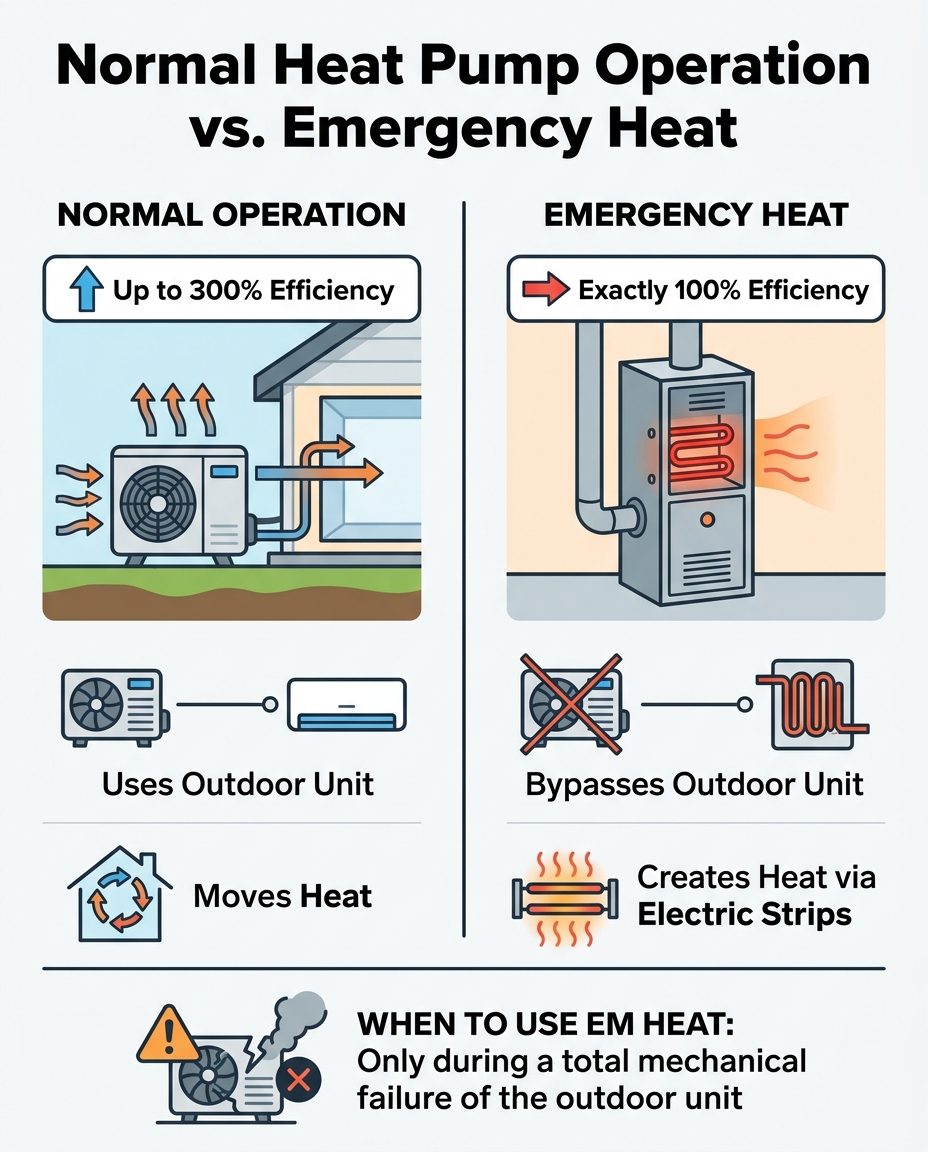
During normal operation, your system extracts ambient heat from the outside air, compresses the refrigerant to raise its temperature, and transfers that warmth indoors. This process is incredibly efficient. Because the system is simply moving existing heat rather than generating it from scratch, modern heat pumps can operate at up to 300% efficiency under normal conditions. That means for every unit of electrical energy the system consumes, it can produce up to three units of heat energy for your home.
Adapting to the Climate
Living in the Central Oregon high desert means experiencing rapid nighttime temperature drops. The weather can be perfectly mild during the afternoon and plummet near freezing by midnight. Modern heat pumps are specifically engineered to handle these dramatic shifts. They use a specialized component called a reversing valve to seamlessly switch between cooling your home in the summer and heating it in the fall and winter.
Your system is designed to handle cold outdoor temperatures efficiently without any manual intervention on your part. It will automatically adjust its cycles to extract the necessary heat, maintaining your indoor comfort even as the desert air cools down rapidly outside. Trusting this normal operation is the most effective way to keep your home comfortable and your energy usage balanced.
What Actually Happens When You Switch to Emergency Heat
When you manually activate the "EM Heat" setting on your thermostat, you are fundamentally changing how your entire HVAC system operates. You are not telling the system to work harder, and you are not telling it to heat the house faster. You are actually telling it to shut down its most efficient components.
Turning on emergency heat physically bypasses the outdoor heat pump unit entirely. The outdoor compressor and fan will stop running. Instead, the system defaults to a secondary backup heat source located inside your home. In most heat pump setups, this backup source consists of electric resistance heating strips.
To visualize how these strips work, think of the glowing red coils inside a giant toaster or a hairdryer. Electricity runs through these metal coils, they get intensely hot, and the indoor blower fan pushes air over them to warm your house. While understanding your thermostat's modes and settings is important, recognizing the efficiency drop of this specific mode is crucial.
Comparing the Two Heating Modes
• How it works — Normal Heat Pump Operation: Extracts ambient heat from outdoor air and moves it indoors. — Emergency Heat (EM Heat): Bypasses outdoor unit; uses indoor electric resistance coils.
• Efficiency Level — Normal Heat Pump Operation: Up to 300% efficient (moves heat). — Emergency Heat (EM Heat): Exactly 100% efficient (creates heat).
• Primary Component — Normal Heat Pump Operation: Outdoor compressor and refrigerant lines. — Emergency Heat (EM Heat): Indoor electric resistance strips.
• Energy Consumption — Normal Heat Pump Operation: Low to moderate, highly optimized. — Emergency Heat (EM Heat): Extremely high, draws massive electrical current.
• When to Use — Normal Heat Pump Operation: Every day, all fall and winter long. — Emergency Heat (EM Heat): Only during a total mechanical failure of the outdoor unit.
Electric resistance heating operates at exactly 100% efficiency. While that sounds perfect, in the world of HVAC, it means one unit of electricity creates exactly one unit of heat. Compared to the 300% efficiency of normal heat pump operation, emergency heat requires significantly more energy to produce the exact same amount of warmth. "Emergency" means a mechanical emergency with the outdoor equipment, not a weather emergency or a sudden desire to heat a cold room faster.

The Defrost Cycle: Why Your System Isn't Broken
One of the main psychological triggers that causes homeowners to unnecessarily switch to EM Heat is witnessing their system go into its normal defrost cycle. During cold, humid nights in the fall and winter, moisture in the air can freeze on the outdoor coils of your heat pump. This frost buildup is perfectly normal, but if left unchecked, it would eventually block airflow and prevent the system from extracting heat.
To prevent this, your heat pump is equipped with an automatic defrost mode. When sensors detect ice buildup, the system temporarily reverses its operation. It sends hot refrigerant back to the outdoor unit to melt the ice. During a recent routine fall maintenance visit, one of our technicians did an above-and-beyond job explaining this exact heating system process to a customer, helping them understand that these strange sounds and sights were completely normal and did not require manual intervention.
Here is exactly what a normal defrost cycle looks and sounds like, so you don't panic and reach for the emergency switch:
1. The outdoor fan stops: The fan on top of the outdoor unit will suddenly stop spinning. This allows the heat to build up inside the unit to melt the frost faster.
2. A loud "whoosh" sound occurs: You may hear a distinct shifting or whooshing noise as the reversing valve changes the flow of the refrigerant.
3. Steam rises from the unit: As the frost melts, you will likely see a cloud of steam rising from the outdoor equipment. This is just water vapor, not smoke.
4. Cooler air blows indoors: Because the system is temporarily using indoor heat to melt outdoor ice, the air coming from your vents may feel slightly cooler for a few minutes. (Most systems briefly activate the backup heat strips automatically to counteract this, but you may still notice a temperature shift).
The entire defrost cycle usually lasts between five and fifteen minutes. Once the ice is melted, the system will automatically return to its normal, highly efficient heating mode. This temporary cool air or strange noise is not a system failure. Understanding your system's regular habits is the best way to avoid unnecessary panic.
The Financial Impact of Unnecessary Backup Heating
At Mountain View Heating, our commitment to honest, cost-saving advice means we want to protect your household budget just as much as we want to keep your equipment running smoothly. We frequently educate homeowners on the financial consequences of using the EM Heat setting improperly, because the impact on utility bills can be severe.
When you rely on electric resistance strips, your energy usage spikes dramatically compared to the highly efficient heat transfer process of normal operation. The electrical draw required to heat those internal metal coils is massive. If you switch your thermostat to emergency heat because you think it will warm up the house faster on a chilly September morning, you are forcing your energy meter to spin at an alarming rate.
Running EM Heat for even a few days can lead to absolute utility bill shock at the end of the month. Many homeowners who accidentally leave this setting on for a week or more are stunned by their subsequent energy statements. It is critical to reiterate that EM Heat does not warm the house "better" or "faster" than normal operation. It simply does the job in a highly inefficient, costly way.
Protecting your household budget means keeping the thermostat in its normal setting unless a true mechanical failure occurs. Your system is designed to provide steady, consistent, and efficient comfort. Let it do the job it was engineered to do.
The Golden Rule: When to Actually Use Emergency Heat
If emergency heat is so inefficient, why does the setting exist at all? It is a fail-safe. It is designed solely to keep your home warm and prevent your indoor pipes from freezing if your primary outdoor unit suffers a catastrophic failure. To protect your system and your energy bills, you should follow definitive guidelines on the extremely rare circumstances when this setting should be used.
Here is the definitive checklist for managing your backup heating:
• Rule 1: Physical damage to the outdoor unit. Use the emergency setting only if the outdoor unit has been physically damaged. For example, if a heavy tree branch falls and crushes the fan, or if a severe ice storm encases the entire unit in solid, unyielding ice that the defrost cycle cannot melt.
• Rule 2: Complete unresponsiveness. Use it if the outdoor unit is completely unresponsive, making horrific grinding noises, or continuously tripping your electrical breaker. In these cases, switch to EM heat to stay warm while you wait for a professional technician to arrive.
• Rule 3: Weather is not an excuse. Never use the emergency setting just because the outdoor temperature has dropped below freezing. Your heat pump is designed to handle cold weather.
• Rule 4: Immediate action is required. If you must use EM Heat due to a breakdown, schedule an inspection immediately. The goal is to get the primary, efficient system back online as quickly as possible so you aren't relying on expensive electric strips for long.
If you suspect your system isn't running as efficiently as it should, or if you find yourself tempted to use the backup heat, it is time to schedule a heat pump tune-up. Preventative maintenance ensures that your outdoor unit is ready to handle the fall and winter workload without needing to fall back on inefficient emergency settings.
Frequently Asked Questions About Heat Pump Settings
When should I turn on emergency heat?
You should only turn on emergency heat when the outdoor heat pump unit has suffered a mechanical failure, is physically damaged, or is completely unresponsive. It is designed strictly as a backup system to keep your home warm while you wait for a repair technician. Do not turn it on simply because the weather is cold, as modern heat pumps are fully capable of extracting heat from freezing air.
Why is my electric bill so high with emergency heat?
Emergency heat uses electric resistance strips, which require substantially more electricity than the heat pump's normal refrigerant cycle. Because electric resistance heating operates at a lower efficiency rate (creating heat rather than moving it), it causes your energy meter to spin much faster. Relying on this setting for even a few days can result in massive energy spikes and unexpected utility bill shock.
What does emergency heat actually do?
Activating emergency heat shuts off the outdoor heat pump unit and relies entirely on a secondary, backup heat source located inside the home. In most systems, this backup consists of heavy-duty electric coils that act like a giant toaster to warm the air. It serves as a vital fail-safe to keep your family warm and your pipes from freezing if the primary outdoor system breaks down.
Should I leave my heat pump on emergency heat?
No, you should never leave a system on emergency heat long-term due to the immense energy draw it requires. It should only be used as a temporary stopgap measure while waiting for an HVAC professional to repair the primary unit. Leaving it on indefinitely will place unnecessary strain on your electrical system and result in severely inflated energy costs.
How long can you run emergency heat?
You can safely run emergency heat as long as necessary to keep the home warm during a breakdown, but it should be measured in hours or days, not weeks. The mechanical components are designed to run continuously if needed, but prolonged use will result in severe energy inefficiency. You should contact a repair technician the moment you switch the system over to minimize how long you rely on the backup strips.
Keep Your Heat Pump Running Efficiently All Season
Understanding your thermostat settings is the single best way to prevent utility bill shock as we move deeper into the heating season. The mechanics of your system are designed to provide maximum comfort with minimal energy use, provided they are allowed to operate as intended. Reiterate the definitive rule in your household: leave the system in its normal mode unless a true mechanical failure occurs with the outdoor unit.
As the crisp September air settles into the high desert, now is the perfect time to have your system inspected. A professional evaluation during the early fall ensures that your normal heating cycle, reversing valve, and defrost modes are all working perfectly before the deep winter freeze arrives. If you suspect your primary heat pump is struggling to keep up, or if you want the peace of mind that comes with a thorough system check, reach out to a local expert. Keeping your equipment well-maintained ensures you get a clear, non-technical explanation of how your system operates, and more importantly, it keeps those backup resistance coils exactly where they belong—in standby mode.