


The Myth of "Thicker is Better" for Wildfire Smoke
When deciding between HEPA and MERV 13 filters for smoke season, the biggest misconception homeowners fall for is that the thickest, most restrictive filter is automatically the safest choice. At Mountain View Heating, Inc., a pattern we see often during a Bend OR fire event is empty hardware store shelves where the highest-rated filters used to be. The natural instinct is to buy the strongest barrier possible to keep hazardous outdoor air from entering your living space. However, residential cooling systems are engineered to move a specific volume of air, and they rely on a delicate balance of intake and output to function correctly.
Slapping a highly restrictive filter into a standard residential unit is one of the fastest ways to suffocate the blower motor. Instead of achieving pristine indoor air, you often end up with a system that continuously overheats, trips circuit breakers, or fails entirely just when you need it most during the summer heat. The true challenge lies in finding the exact middle ground between capturing microscopic smoke particles and allowing your equipment to breathe. If you are concerned about your home's air quality and want to explore safe, effective upgrades, our team provides comprehensive professional HVAC services to help you navigate these choices without compromising your equipment.
The Cost of Suffocating Your HVAC System
Your air conditioner or air handler works like a giant set of lungs. It needs to pull in enough return air to condition and push back out through your supply vents. When you block that intake with an overly dense filter, the blower motor has to work twice as hard just to pull a fraction of the necessary air. This immediate strain leads to increased energy consumption, premature mechanical wear, and a highly uncomfortable home where the cool air simply stops flowing from the registers.
Understanding PM2.5 and the Challenge of Smoke Filtration
To understand why upgrading your filter is necessary in the first place, you have to look at what wildfire smoke actually is. Smoke is not a gas; it is a complex mixture of gases and fine microscopic particles. The most dangerous component is known as PM2.5, which stands for particulate matter that is 2.5 microns in diameter or smaller. To put that into perspective, a single strand of human hair is roughly 70 microns across. These particles are so small that they bypass the body's natural respiratory defenses and enter the bloodstream directly.
During the July wildfire smoke season, the air quality index (AQI) in the High Desert frequently pushes into hazardous levels. When the outdoor air is thick with wood smoke and ash, a standard 1-inch fiberglass filter—the cheap, see-through filters often rated between MERV 1 and MERV 4—will do absolutely nothing to protect you. In our years of serving Central Oregon, we've seen firsthand how these basic filters are designed solely to stop large debris like pet hair and dust bunnies from clogging the mechanical components of your AC. They are entirely useless against microscopic smoke particles. When the AQI spikes, you need immediate, effective indoor air quality solutions to keep your family safe.
Why Standard Filters Fail During Fire Season
Standard filters rely on simple interception. If a particle is larger than the holes in the fiberglass web, it gets caught. Because PM2.5 particles are microscopic, they flow right through the wide gaps in a basic filter and circulate endlessly through your ductwork. Upgrading your filtration means moving to a filter medium that uses dense pleating and electrostatic charges to pull these tiny particles out of the airstream. But as the filter media gets denser to catch smaller particles, the resistance to airflow increases dramatically.
True HEPA Filters: Unmatched Filtration, Unmatched Restriction
HEPA stands for High-Efficiency Particulate Air. By definition, a True HEPA filter must capture at least 99.97% of particles that are exactly 0.3 microns in size. This is an incredibly high standard of filtration, which is why HEPA filters are the default choice for hospital operating rooms, pharmaceutical cleanrooms, and specialized manufacturing environments. Because they are so effective at scrubbing the air of virtually all contaminants, many homeowners assume they should install one in their central HVAC system.
However, True HEPA filters represent a mechanical disaster for a standard residential cooling system. The filter media is so incredibly dense that it creates a massive barrier to airflow. A typical air handler installed in a Bend OR home is simply not equipped with a blower motor powerful enough to push or pull air through a True HEPA filter. Attempting to force a HEPA filter into a standard 1-inch or 4-inch filter slot is essentially the same as sliding a piece of solid cardboard over your return vent.
The Physics of Airflow Restriction
When the blower motor tries to pull air through a HEPA filter, the resistance is so high that the motor begins to overheat almost immediately. The system will either shut down on a high-limit safety switch, or the motor will burn itself out trying to overcome the restriction. True HEPA filtration in a whole-home setting requires specialized, bypass ductwork systems equipped with their own dedicated, high-powered fans. You can never simply swap a standard AC filter for a True HEPA filter without causing catastrophic damage to your equipment.
MERV 13 Filters: The High-Efficiency Standard and Its Hidden Risks
Because True HEPA is off the table for standard filter slots, MERV 13 has become the gold standard for residential smoke protection. MERV stands for Minimum Efficiency Reporting Value, and a MERV 13 filter is highly effective, capable of capturing up to 90% of PM2.5 particles. For most homeowners, this provides a massive, noticeable improvement in indoor air quality during a smoke event. Unlike HEPA filters, MERV 13 filters are readily available in standard sizes and are marketed specifically for residential use.
But MERV 13 filters carry their own hidden risks. While they fit into standard slots, they still utilize a very dense, tightly woven filter media. This density results in a significant MERV 13 static pressure drop. Static pressure is the measure of resistance to airflow within your ductwork. When you insert a restrictive filter, the static pressure spikes. If your ductwork is already undersized—a pattern our technicians see constantly in Bend neighborhoods—or if your blower motor is older, the added resistance of a MERV 13 filter can push the system past its operational limits. If you suspect your system is struggling to breathe, having a professional evaluate your air distribution and airflow is a critical first step before upgrading your filter.
The Danger of Frozen Coils in Summer Heat
The risk of a high static pressure drop compounds rapidly under heavy system loads. In the dry, high-desert heat of summer, your air conditioning system is already running constantly to maintain a comfortable temperature. Air conditioning relies on a steady, robust flow of warm return air passing over the indoor evaporator coil to prevent the coil from getting too cold.
Signs your system is suffocating include:
• Weak airflow: You can barely feel the cool air coming out of your supply vents.
• Strange noises: The blower motor sounds like it is straining, whining, or ramping up and down erratically.
• Ice buildup: Visible ice forming on the copper refrigerant lines near your indoor unit.
• Short cycling: The system turns on and off rapidly without ever actually cooling the house.
When a restrictive MERV 13 filter chokes off that vital airflow, the evaporator coil drops below freezing. The natural condensation on the coil turns to solid ice, eventually encasing the entire unit in a block of ice and halting all cooling entirely.
Side-by-Side Comparison: HEPA vs. MERV 13 for Residential Systems
To make the best choice for your home, it helps to see exactly how these two high-efficiency options stack up against each other when applied to a standard residential HVAC system. While both offer excellent particle capture, their mechanical impact on your equipment is vastly different.
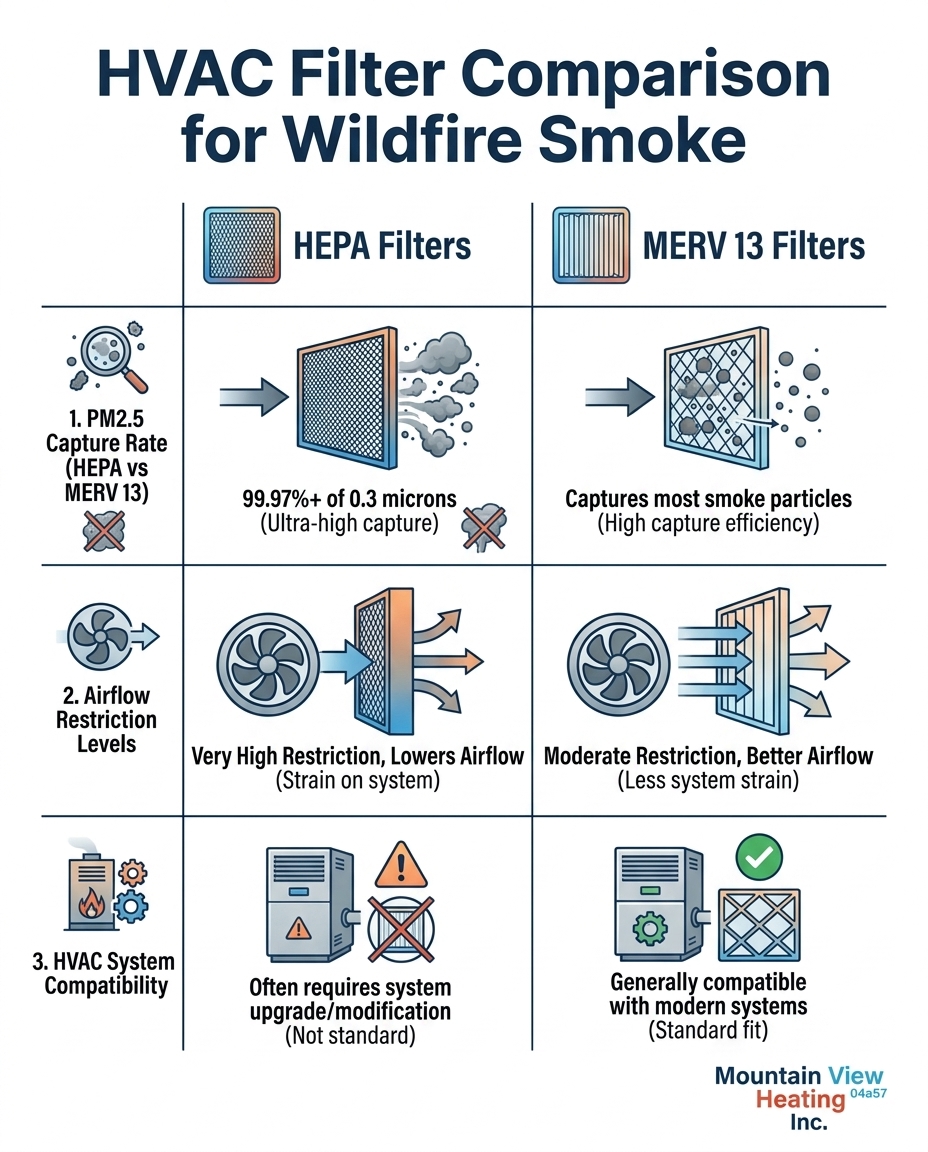
• PM2.5 Capture Rate — True HEPA Filter: 99.97% (at 0.3 microns) — MERV 13 Filter: Up to 90% (at 2.5 microns)
• Airflow Restriction — True HEPA Filter: Extreme (Acts like a solid wall) — MERV 13 Filter: High (Creates significant MERV 13 static pressure drop)
• HVAC Compatibility — True HEPA Filter: Requires specialized bypass systems — MERV 13 Filter: Fits standard slots, but requires system evaluation
• Risk of Blower Failure — True HEPA Filter: Guaranteed in standard systems — MERV 13 Filter: Moderate to High (Depends on existing ductwork)
The Safest Strategy: Hybrid Filtration for Heavy Smoke
When the July wildfire smoke season arrives, you do not have to make an "either/or" choice between protecting your lungs and protecting your HVAC equipment. The most effective, mechanically safe approach is to use a hybrid filtration strategy. Instead of forcing your central air system to do all the heavy lifting, you divide the labor between your HVAC equipment and supplemental devices.
At Mountain View Heating, we typically recommend installing a MERV 11 filter in your main HVAC system as the safest strategy. A MERV 11 filter is highly capable of capturing a large percentage of smoke and ash, but it has a significantly lower static pressure drop than a MERV 13. This allows your air handler to breathe easily, keeping your blower motor cool and your evaporator coils completely free of ice. Your central system acts as the first line of defense, scrubbing the majority of the particulate matter out of the air as it circulates through the house.
Building a Two-Tiered Filtration Strategy
To achieve the pristine air quality you want without the mechanical risks, supplement that MERV 11 central filter with standalone True HEPA room purifiers. Place these portable units in high-traffic areas like the living room and primary bedrooms. Because these standalone units have their own dedicated fans designed specifically to push air through HEPA media, they pose zero risk to your central air conditioner. If you are wondering are air purifiers actually effective against smoke, the answer is a resounding yes—when deployed correctly, they are the perfect complement to a safe, breathable central HVAC filter.
Why a Professional Static Pressure Check is Essential
Every single HVAC system has a maximum static pressure limit, which is designated by the manufacturer. This number dictates exactly how much resistance the blower motor can handle before it begins to fail. Guessing which filter your system can handle is a gamble that frequently ends with a costly emergency repair bill. Before you upgrade to a dense, restrictive filter, you need to know exactly what your specific system can tolerate.
As part of routine care, a technician can measure your system's exact airflow resistance. Staying on top of routine HVAC maintenance ensures that your equipment is evaluated before the stress of fire season hits. Our team at Mountain View Heating brings deep local expertise in Central Oregon climates, ensuring homeowners get maximum smoke protection without risking an expensive blower motor burnout.
What Happens During a Static Pressure Test?
A professional static pressure check removes all the guesswork from your filtration strategy. Here is how it works:
1. Initial Measurement: A technician drills small, easily sealed test ports into your supply and return ductwork.
2. Using a Manometer: They insert a specialized digital gauge called a manometer to measure the exact pressure of the air entering and leaving the equipment.
3. Filter Testing: The technician can slide different filters (like a MERV 11 and a MERV 13) into the slot and watch the manometer to see exactly how much the MERV 13 static pressure drop impacts the system.
4. Safe Recommendations: Based on the hard data, the technician will tell you the absolute highest MERV rating your specific system can safely handle without risking a frozen coil or a burned-out motor.
Protecting Your Home's Air and Your HVAC System
Surviving the July wildfire smoke season requires a careful balance. Achieving breathable indoor air is critical for your family's health, but sacrificing your cooling equipment to get there will only lead to expensive breakdowns and uncomfortable days. Remember that thicker is not always better when it comes to standard residential filters.
By relying on a hybrid approach—using a safe, moderately rated filter in your central system alongside standalone HEPA purifiers in your main living spaces—you can effectively protect both your lungs and your equipment. Don't guess when it comes to airflow. Reach out to our Bend OR team for a professional static pressure assessment today to confidently weigh your indoor air quality options and keep your home safe, comfortable, and smoke-free all summer long.
Frequently Asked Questions
Will a MERV 13 filter damage my HVAC?
A MERV 13 filter can damage your HVAC system if your blower motor and ductwork are not designed to handle the increased airflow resistance. The dense media creates a significant static pressure drop, forcing the motor to work harder and potentially leading to overheating. If your system is older or your ductwork is undersized, the restricted airflow can also cause your air conditioning coils to freeze during summer operation. Always have a professional measure your system's static pressure before upgrading to a MERV 13.
Is HEPA or MERV better for wildfire smoke?
HEPA is technically superior at capturing microscopic smoke particles, but it is not viable for standard whole-home HVAC systems. True HEPA filters create massive airflow restriction that will quickly destroy a residential HVAC blower. MERV 13 is the highest practical rating for most residential central air systems, capturing up to 90% of smoke particles. The best strategy is often using a safe MERV filter in your HVAC system while running standalone HEPA purifiers in individual rooms.
What is the highest MERV rating my air conditioner can handle?
The highest safe MERV rating depends entirely on your specific equipment's design, age, and existing ductwork size. While many modern systems can handle a MERV 8 to MERV 11 filter without issue, jumping to a MERV 13 often pushes the system past its maximum static pressure limit. The only way to know for sure is to have an HVAC technician perform a static pressure test with a manometer. This test provides exact data on how much resistance your system can tolerate.
Can I put a HEPA filter in my HVAC system?
No, you should never put a True HEPA filter into a standard residential air handler. A HEPA filter is so dense that it acts essentially like a solid wall, choking off the vital return air your system needs to operate. Forcing a HEPA filter into a standard slot will cause the blower motor to overheat and fail, and it will cause the system to shut down. Whole-home HEPA filtration requires the installation of a separate, dedicated bypass duct system with its own powerful fan.
How often should I change my HVAC filter during a wildfire smoke event?
During a heavy wildfire smoke event, you should check your HVAC filter every single week and expect to replace it every 2 to 4 weeks. High-efficiency filters trap an enormous amount of particulate matter very quickly when the outdoor air quality is hazardous. As the filter loads up with ash and smoke particles, it becomes even more restrictive, increasing the risk of equipment damage. Frequent replacements ensure your system can still pull enough air to function safely.