


The Myth of "Set It and Forget It" During Late Summer
Leaving your thermostat on a single setting year-round doesn't guarantee energy efficiency—in fact, knowing exactly when to switch your heat pump from cooling to auto mode is the key to preventing unnecessary mechanical strain. You might assume that "Auto" mode is always the smartest choice, trusting the smart thermostat to do all the thinking for you. However, managing heat pump settings when days are scorching but nights are near freezing presents a concrete problem for local homeowners. The critical decision point comes down to knowing the precise time to switch from dedicated cooling to automated modes as the season shifts, preventing your system from actively fighting itself.
If you are evaluating how to best manage your home's comfort, understanding how heat pumps operate in our unique climate is the first step toward better efficiency.
During the late-summer August transition, the "set it and forget it" mentality often leads to unexpected utility spikes. In our years of serving Bend, our team at Mountain View Heating, Inc. has seen firsthand how many modern thermostats are marketed on the promise of effortless comfort. The underlying assumption is that the technology knows exactly what your home needs at any given hour. While this might be true in mild, highly stable climates, it creates significant operational issues in regions with drastic weather swings. When you rely entirely on automation during a transitional season, you surrender control over which mechanical components are activating and when.
Taking manual control of your system during these unpredictable weeks is not a step backward in technology; it is a proactive strategy to protect your investment. By understanding the mechanical realities behind your thermostat's digital display, you can make informed decisions that prioritize both your personal comfort and the long-term health of your HVAC equipment.
How Thermostat Modes Dictate Heat Pump Mechanics
To understand why a seemingly helpful setting can cause problems, we need to bypass basic definitions and look at the technical communication between your wall control and your outdoor unit. Your thermostat does not just measure air temperature; it acts as the command center for complex mechanical processes.
1. The Reversing Valve's Role: Heat pumps are unique because they do not burn fuel to create heat, nor do they strictly generate cold air. They move heat from one place to another. The component responsible for switching the system between heating and cooling is the reversing valve. When activated, this physical brass valve shifts internally, reversing the flow of pressurized refrigerant through the system.
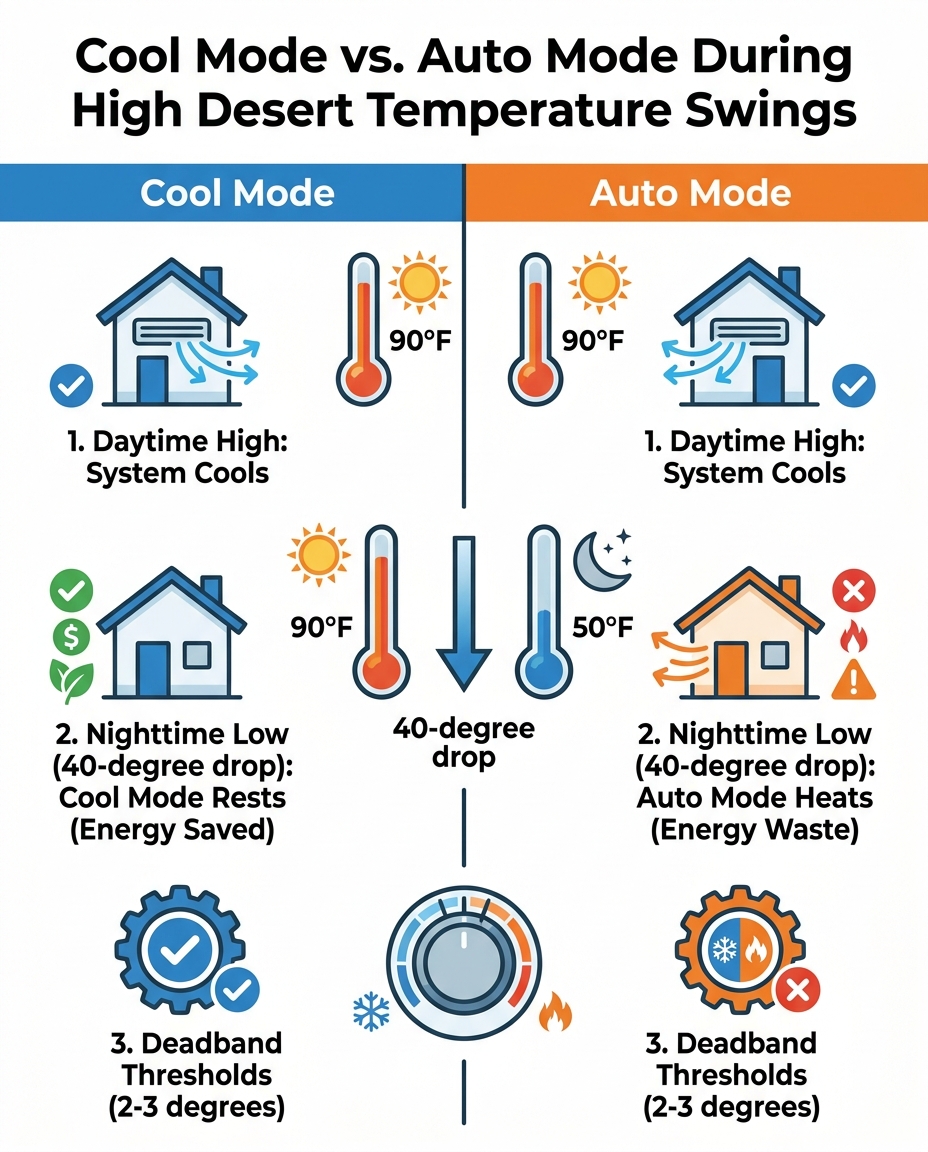
2. Understanding Thermostat Deadbands: A "deadband" is the allowable temperature gap between your heating and cooling setpoints. Typically, this is a 2 to 3-degree buffer. For example, if your target is 72°F, the deadband ensures the air conditioner does not kick on until the room hits 74°F, and the heater does not engage until it drops to 70°F. Understanding your thermostat modes and settings is crucial because the deadband dictates exactly when the system reacts.
3. The Dedicated "Cool" Mode Lock: When you select Cool mode, you are electronically locking the reversing valve into a single position. The thermostat is instructed to only monitor the upper end of the deadband. If the temperature drops below your setpoint, the system simply powers down and rests, completely preventing any unwanted heating cycles.
4. The "Auto" Mode Continuous Monitor: In contrast, Auto mode continuously monitors both ends of the deadband threshold. It stands ready to activate the reversing valve and engage the compressor the moment the ambient temperature crosses either the upper or lower limit. It is highly reactive, designed to maintain a strict temperature range regardless of external weather conditions.
In the Central Oregon high desert, this reactive nature becomes a distinct disadvantage. The mechanics of the reversing valve are robust, but they are not designed to be toggled back and forth multiple times within a single 24-hour period. Every time the mode shifts, the system must equalize pressure, actuate the valve, and restart the compressor—a sequence that consumes significant electricity and places physical stress on the moving parts.
The "Auto Mode" Trap During Extreme Diurnal Temperature Swings
The Problem: Drastic Diurnal Shifts
The Central Oregon high desert is characterized by its lack of humidity. In other parts of the country, atmospheric moisture traps daytime heat, keeping summer nights warm and muggy. Here, the dry air allows heat to escape rapidly into the atmosphere as soon as the sun goes down. This creates a phenomenon known as diurnal temperature variation, where daytime highs can easily drop by 30 to 40 degrees overnight.
The Cause: Breaching the Deadband
This rapid nighttime temperature drop is exactly what springs the Auto mode trap. During a hot late-summer afternoon, your heat pump works diligently to extract heat from your home, pushing cool air inside. By 8:00 PM, the house is perfectly comfortable. But as the outdoor temperature plunges toward freezing in the early hours of the morning, your home's internal temperature begins to slowly drop as well. Around 3:00 AM, the indoor temperature breaches the lower threshold of your thermostat's deadband.
The Resulting Strain and Energy Waste
Because the system is in Auto mode, the thermostat detects the drop and immediately shifts the reversing valve. The heat pump, which was cooling your house just hours prior, now fires up to actively heat it. It burns energy to warm the house back up, only for the sun to rise a few hours later, driving the indoor temperature back up and forcing the system to switch back to cooling. The system ends up fighting itself.
High temperatures already drive heavy system demand. Our technicians at Mountain View Heating, Inc. frequently see the impact of this during late-summer heat waves, when new ductless heat pump system installations spike and our service teams work extended hours to keep up with the volume of calls. When systems are already running non-stop to combat high daytime temperatures, adding unnecessary nighttime heating cycles in Auto mode only compounds the mechanical strain and increases the risk of a breakdown.
Side-by-Side: Cool Mode vs. Auto Mode in Late Summer
Generic manufacturer thermostat manuals are written for average climates where summer nights stay relatively warm. Those manuals highly recommend Auto mode for ultimate convenience. However, applying generic factory advice to a specialized environment often leads to higher utility bills and premature equipment wear. As your trusted local HVAC experts in Bend, our team recommends a different approach tailored specifically for the high desert.
To help you make the best choice for the late-summer August transition, here is a direct comparison of how these two settings perform under extreme daily temperature swings.
• Energy Consumption — Dedicated Cool Mode: Minimizes waste by allowing the system to rest entirely when nighttime temperatures drop. — Auto Mode: Spikes utility usage by actively heating the home during the night after cooling it all day.
• System Wear and Tear — Dedicated Cool Mode: Reduces stress by locking the reversing valve in one position for the duration of the season. — Auto Mode: Maximizes wear by forcing the reversing valve and compressor to actuate multiple times a day.
• Comfort Levels — Dedicated Cool Mode: Allows for natural, gentle nighttime cooling as the house settles. — Auto Mode: Aggressively maintains a rigid temperature, often leading to a stuffy feeling at night.
• Best Climate Application — Dedicated Cool Mode: Vastly superior for swing seasons with extreme 30 to 40-degree temperature drops. — Auto Mode: Best reserved for mild, stable seasons where the weather remains consistent day and night.
The data clearly points to Cool mode as the superior choice during this specific time of year. By simply locking out the heating function, you align your home's mechanical cooling with the natural cooling provided by the local climate.

The Hidden Costs of Reversing Valve Wear and Short-Cycling
Leaving a system in Auto mode when it shouldn't be does more than just inflate your monthly electricity bill; it introduces significant mechanical consequences. One of the most damaging results of a confused thermostat is a phenomenon known as short-cycling. Short-cycling occurs when the heat pump turns on and off too rapidly because the thermostat is constantly reading conflicting ambient temperature shifts.
The mechanical stress on the reversing valve is immense when short-cycling occurs in Auto mode. The valve is forced to actuate repeatedly within a short timeframe, shifting pressurized refrigerant back and forth. Over time, this constant toggling can cause the internal seals of the valve to degrade, leading to refrigerant leaks or a valve that becomes physically stuck in one position. If the reversing valve fails, your system will be permanently locked in either heating or cooling until a major repair is performed.
Furthermore, short-cycling prevents the compressor from completing a full, efficient run cycle. The compressor draws the most amperage during startup. If it is forced to start, stop, and restart multiple times an hour, the electrical components overheat, and the compressor's lifespan is drastically reduced. Preventing this unnecessary wear extends the lifespan of critical cooling components and delays the need for expensive interventions.
Proactive thermostat management is a highly effective form of preventative maintenance. By taking control of your settings, you are actively protecting your air conditioning and heating capabilities for the years ahead. In the Central Oregon high desert, where equipment works exceptionally hard, minimizing unnecessary cycles is the easiest way to preserve your system's health.
Checklist: When Is the Right Time to Finally Switch to Auto?
If Cool mode is the best choice for late summer, how do you know when it is finally time to make the transition? As the true heating season approaches, you will need to adjust your strategy. Use this actionable checklist to determine the right time to transition your settings.
• Monitor daytime high temperatures: Wait for the afternoon highs to consistently drop below the threshold where active cooling is required. If opening a window provides enough relief during the warmest part of the day, your system no longer needs to be locked in Cool mode.
• Evaluate nighttime lows: Pay attention to how your house feels at 6:00 AM. You should switch to Auto or dedicated Heat mode when your home's natural insulation can no longer maintain a safe, comfortable overnight temperature without mechanical assistance.
• Assess overall system performance: Use the late-summer to fall transition as a reminder to check how the equipment handled the hotter months. Did it struggle to keep up? Were there unusual noises? Identifying warning signs early is critical before the heavy heating season begins.
Do not wait for a complete breakdown to evaluate your system's readiness for winter. Our team at Mountain View Heating, Inc. recently helped a local Bend homeowner who experienced a complete heating unit failure over a busy Labor Day weekend. We had to dispatch our service team on a Saturday to diagnose the problem, bring in temporary space heaters, and promptly replace the unit right as the back-to-school season was kicking off. Using the late-summer August transition to proactively check your settings and schedule professional attention helps you avoid these stressful, poorly-timed emergency scenarios.
Frequently Asked Questions About Heat Pump Settings
Is it better to leave a heat pump on auto or cool?
In climates with drastic day-to-night temperature shifts, Cool mode is the better choice to prevent the system from fighting itself. Auto mode is best reserved for mild seasons where temperatures remain relatively stable around the clock. By locking the system in Cool during hot months, you prevent it from wasting energy by turning on the heat during chilly high-desert nights.
Does auto mode use more electricity on a heat pump?
Yes, Auto mode frequently uses more electricity during transitional seasons. Because it continuously monitors for both heating and cooling needs, it will activate the compressor more often than a dedicated mode. Every time the system switches from cooling to heating to compensate for a nighttime temperature drop, it consumes significant electrical power.
Why does my heat pump switch from cool to heat unexpectedly?
This unexpected switching happens in Auto mode when the ambient indoor temperature drops below the thermostat's lower deadband threshold. It is a very common occurrence during cold high-desert nights that follow hot days. The thermostat senses the chill and automatically reverses the system's operation to warm the house back to the setpoint.
What is the ideal deadband setting for high desert climates?
A wider deadband of at least 3 to 4 degrees is often ideal for regions with extreme temperature swings. A wider gap prevents the thermostat from overreacting to rapid, natural cooling in the evening. It allows the home's temperature to fluctuate slightly without triggering an unnecessary mechanical response from the heat pump.
Can frequent switching damage the reversing valve?
While reversing valves are built to be durable, frequent and unnecessary switching accelerates mechanical wear and tear. Forcing the valve to actuate multiple times a day due to a confused Auto mode setting stresses the internal components. Over time, this can lead to the valve sticking or failing entirely, requiring professional replacement.
Optimize Your Heat Pump for the Changing Seasons
Taking manual control of your thermostat modes is one of the simplest and most effective ways to prevent energy waste and mechanical strain. By understanding how diurnal temperature shifts affect your equipment, you can avoid the common pitfalls of automated settings. Our team at Mountain View Heating, Inc. strongly recommends utilizing dedicated Cool mode during the extreme swings of the late-summer August transition to protect your reversing valve and keep your utility costs manageable.
As we move closer to the true heating season, ensuring your system is prepared for the heavy lifting of winter is essential. If your system has been short-cycling, or if you suspect your thermostat is no longer communicating accurately with the outdoor unit, professional calibration is the next step. Don't wait until the first freeze to find out your system is struggling. Schedule a comprehensive heat pump tune-up today to ensure your reversing valve, compressor, and thermostat are perfectly synchronized for the months ahead.