


Why Late Summer Is the Critical Window for Humidity Control Planning
August is here, and while the days are still warm, Central Oregon's crisp autumn is just around the corner. Evaluating whole-home humidifiers before the dry winter arrives is the smartest move you can make for your indoor comfort this season. Most homeowners wait until the first major freeze to think about their indoor air quality. By the time November rolls around and the furnace is running nonstop, indoor humidity plummets, and local heating contractors are fully booked with emergency calls.
Late summer provides the ideal window for proactive HVAC upgrades before the fall rush begins. Upgrading your system in August means you have the luxury of time to evaluate your options, schedule a professional installation, and ensure your home is fully prepared for the extreme dry-out that accompanies the heating season. One local homeowner who purchased a new house with inadequate air distribution reached out during late summer. By performing a thorough system analysis and coordinating the necessary servicing early, the work was completed timely with no callbacks, vastly improving the home's comfort long before the cold weather hit.
Integrating proper moisture control systems now ensures readiness for the upcoming winter. If you are starting to plan your cold-weather upgrades, exploring indoor air quality solutions today will save you from the scramble when temperatures drop.
Understanding the Extreme Moisture Demands of a High Desert Winter
The environment in Central Oregon presents unique challenges for indoor climate control. Standard humidity solutions that work perfectly well in coastal or midwestern climates often fall completely short here. To understand why your home needs specialized equipment, you have to look at the specific environmental factors at play.
The Science of High-Elevation Humidity
Bend sits at roughly 3,600 feet in elevation. At this altitude, the air is naturally arid year-round. However, the situation becomes exceptionally severe when winter temperatures drop below freezing. Cold air physically cannot hold as much moisture as warm air. When you take that freezing, bone-dry outdoor air and pull it into your home, your heating system warms it up. Warming the air increases its capacity to hold moisture, but since no new moisture was added, the relative humidity inside your home drops drastically.
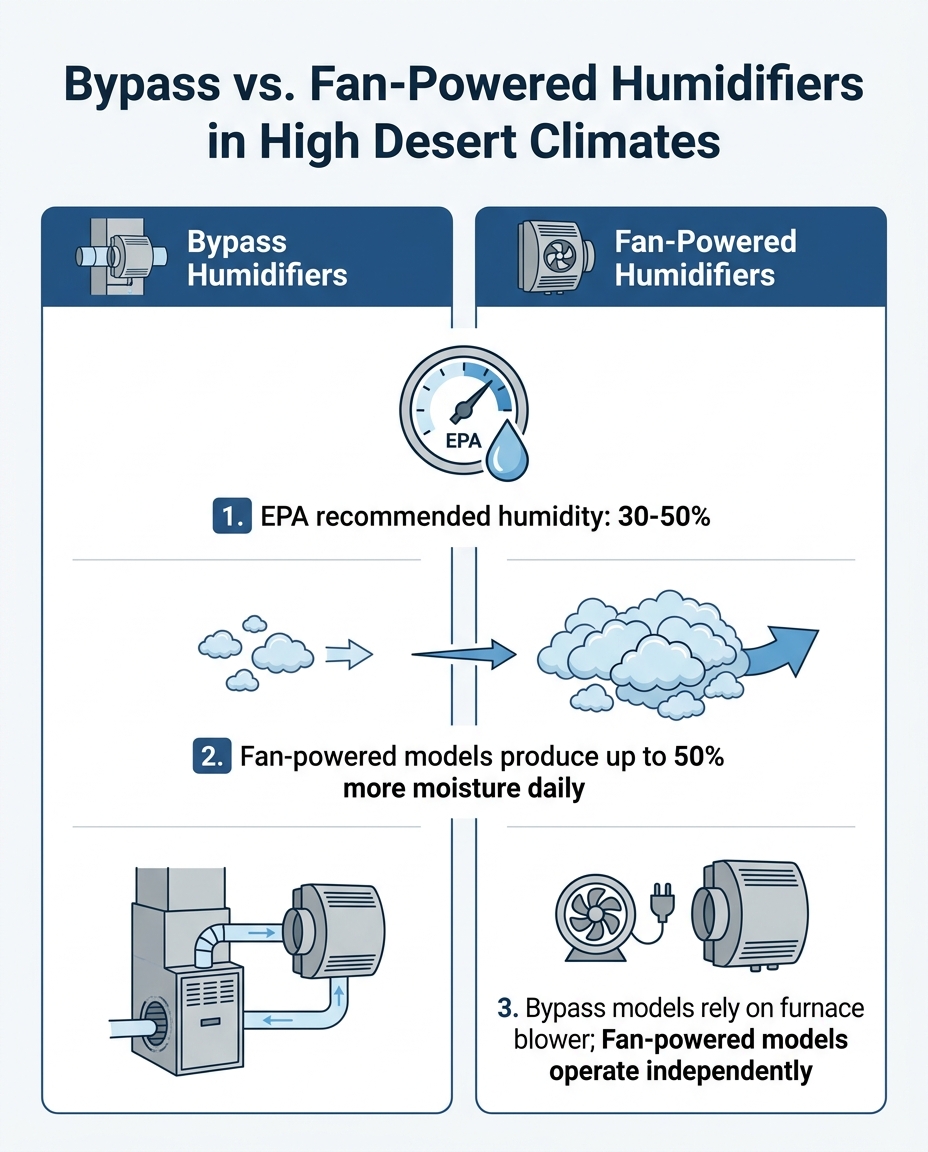
The EPA recommends maintaining an indoor relative humidity between 30% and 50% for optimal health, comfort, and home preservation. Without intervention, a high desert home running a furnace constantly during a deep freeze can see indoor humidity plummet well below 20%. This is drier than most natural deserts.
Cascading Effects on Your Home
When humidity drops to these extreme lows, the effects are immediate and noticeable. A robust whole-home system is required to combat these specific climatic extremes. Here is exactly what happens when your home lacks adequate moisture:
1. Respiratory discomfort: Dry air pulls moisture directly from your mucous membranes. This leads to dry throats, bloody noses, and irritated sinuses, making your family more susceptible to winter colds and respiratory infections.
2. Damage to woodwork: Hardwood floors, wooden furniture, and cabinetry require a stable moisture level. When the air dries out, wood shrinks, causing floors to gap, doors to warp, and expensive furniture to crack.
3. Increased energy costs: Dry air actually feels colder against your skin than humidified air at the exact same temperature. Homeowners often push their thermostats higher to compensate, forcing their heating system services into overdrive and driving up monthly utility bills.
4. Static electricity buildup: Constant static shocks are a clear indicator that your home's humidity has dropped below the safe threshold of 30%.
Bypass Humidifiers: How They Work and When They Make Sense
When evaluating bypass vs. fan-powered humidifiers, it helps to start with the simpler technology. Bypass humidifiers are the most common type of whole-home moisture system installed across the country. They are highly effective in the right environment, but understanding their mechanics is key to knowing if they are right for your specific home.
The Mechanics of Bypass Systems
A bypass humidifier is installed directly onto your HVAC system's ductwork. It relies entirely on the home's furnace blower to function. The system uses a bypass duct that connects the warm air supply plenum to the cold air return duct. When the furnace turns on, the pressure difference forces warm, heated air through the bypass duct and across a water panel (also known as an evaporator pad). As the warm air passes through the water-soaked panel, it absorbs moisture and carries it throughout the home's duct system.
Pros and Cons of Bypass Units
Because of their design, bypass units offer a specific set of advantages and limitations. They only add moisture to the air when the furnace is actively running, which is an important factor to consider in a high desert climate.
• Pro: Simpler mechanical design. With fewer moving parts and no internal motor, bypass units are generally highly reliable and have a lower upfront installation cost.
• Pro: Silent operation. Since they use the existing furnace blower to move air, they do not add any additional noise to your utility closet or basement.
• Con: Dependent on furnace cycles. The humidifier can only operate when the heating system is running. If your home is well-insulated and the furnace shuts off quickly, the humidifier shuts off with it.
• Con: Lower total output. In extreme dry climates, bypass models may struggle to achieve the optimal 30% to 50% humidity if the furnace cycle is too short to deliver the necessary moisture.
Fan-Powered Humidifiers: Independent Moisture Delivery for Arid Climates
For homes facing severe moisture deficits, a step up in technology is often required. Fan-powered humidifiers are designed to overcome the primary limitation of bypass units: the reliance on the furnace's heating cycle. These systems are engineered for high-demand environments where moving large volumes of moisture is necessary.
How Internal Fans Change the Game
Fan-powered units feature their own internal electric fan to blow air directly across the water panel. Instead of requiring a bypass duct to route air from the supply to the return, the built-in fan forces the heated air through the evaporator pad and pushes the humidified air directly into the supply plenum. This fundamental change in design allows the unit to operate and distribute humidity even when the furnace isn't actively heating, provided the HVAC blower is circulating air.
During a routine winter service call, a technician quickly identified and repaired a significant problem with a home's fan-powered humidifier. Because these units operate independently and push high volumes of moisture, getting the system back online immediately restored the home's moisture balance, completely resolving the dry-air discomfort and exceeding the homeowner's expectations for winter comfort.
Pros and Cons of Fan-Powered Units
When comparing bypass vs. fan-powered humidifiers, the fan-powered models clearly excel in output, making them highly attractive for high desert winters.
• Pro: Massive moisture output. Fan-powered units can produce up to 50% more moisture daily than equivalent bypass models, easily keeping up with the extreme dryness of a Central Oregon winter.
• Pro: Independent operation. They can run whether the furnace is actively burning fuel or just circulating air, ensuring your home reaches its target humidity faster and stays there consistently.
• Pro: Space-saving installation. Because they do not require bypass ductwork connecting the supply and return plenums, they can often be installed in tighter utility closets where space is at a premium.
• Con: Requires an electrical circuit. The internal fan requires a dedicated power connection, which slightly increases the complexity of the initial installation.
Head-to-Head: Which Technology Wins in Central Oregon?
Choosing the right system for your home requires looking beyond generic national advice. What works in a humid coastal city will not necessarily work in Bend, OR. Local HVAC experts evaluate home airflow and actual furnace usage patterns to recommend the right technology, rather than relying solely on manufacturer spec sheets. If your home has short heating cycles, a bypass unit might never run long enough to properly humidify the space.
Side-by-Side Comparison
To help you make an informed decision before the late summer window closes, here is a direct comparison of how the two technologies stack up against the specific demands of a high desert winter.
• Moisture Output Capacity — Bypass Humidifier: Moderate. Suitable for smaller homes or less extreme climates. — Fan-Powered Humidifier: High. Produces up to 50% more moisture; ideal for severe high desert dryness.
• HVAC Compatibility — Bypass Humidifier: Requires specific ductwork configurations (bypass tube) that may not fit all utility closets. — Fan-Powered Humidifier: More compact footprint as it does not require a bypass tube; fits tighter spaces.
• Operating Independence — Bypass Humidifier: Only operates when the furnace is actively heating the home. — Fan-Powered Humidifier: Operates independently of the heating cycle, requiring only the blower fan.
• Efficiency & Speed — Bypass Humidifier: Both utilize water efficiently, but bypass units take longer to reach the target humidity. — Fan-Powered Humidifier: Achieves target humidity significantly faster due to the internal powered fan.
• Overall Regional Recommendation — Bypass Humidifier: Acceptable for well-sealed homes with longer furnace run times. — Fan-Powered Humidifier: The preferred choice for Central Oregon homes during deep freezes.
Ultimately, the overall recommendation for high desert homes leans heavily toward fan-powered units for consistent performance. Because they do not rely on your furnace's heat cycle, they guarantee that your home maintains that crucial 30% to 50% humidity range regardless of how often your thermostat calls for heat. Just like adding an air purifier, selecting the right humidifier is about matching the equipment's capacity to your home's specific environmental challenges.

Long-Term Care and Maintenance for Whole-Home Systems
Regardless of whether you choose a bypass or fan-powered model, your whole-home humidifier is a hard-working piece of machinery. Throughout a long, dry winter, hundreds of gallons of water will pass through the system. In regions with hard water, minerals like calcium and magnesium are left behind as the water evaporates. Educating yourself on the necessary upkeep ensures your chosen system performs efficiently throughout the entire winter.
Pre-Season Preparation Steps
Late summer is the pre-heating season, making it the perfect time to perform annual maintenance. A neglected humidifier can become clogged with scale, leading to water leaks, reduced output, or even damage to your furnace. Here is a checklist of what needs to be done to keep your system running at peak performance:
• Annual water panel replacement: The water panel (evaporator pad) is the heart of the system. Over a single winter, it becomes heavily coated in mineral deposits. Replacing this pad annually before the heating season begins is absolutely crucial for proper airflow and moisture evaporation.
• Inspect the water feed tube: The small tube that delivers water to the distribution tray can easily become clogged with sediment. Regular inspection ensures a steady, even flow of water across the panel.
• Clear the drain line: Humidifiers flush excess water to prevent stagnant pooling. Inspecting and clearing the drain line prevents blockages and costly water leaks around your HVAC equipment.
• Humidistat calibration: Professional maintenance ensures the humidistat is accurately reading the indoor air and communicating correctly with the HVAC system. An uncalibrated humidistat will either under-humidify your home or waste water by running constantly.
Staying on top of these tasks is simple when you incorporate them into a routine maintenance plan. Having a professional clean and calibrate the unit in August means you will have total peace of mind when the November freezes arrive.
Secure Your Home's Comfort Before the First Freeze
The transition from late summer to the depths of winter happens quickly in Central Oregon. Don't wait for the first winter freeze to realize your home's air is uncomfortably dry, your hardwood floors are separating, and your family is dealing with constant static shocks and dry sinuses. The most critical step is taking action while the weather is still mild and HVAC schedules are open.
Evaluate your options today and schedule a professional installation while late-summer availability lasts. Whether your home's layout is best suited for the reliable simplicity of a bypass unit or the high-output independence of a fan-powered system, getting the equipment in place now is the best way to achieve the ideal 30% to 50% humidity balance. Secure a healthier, more comfortable environment for your family by scheduling your whole-home humidity control installation before the harsh weather sets in.
Frequently Asked Questions
What is the difference between a bypass and a fan-powered humidifier?
The primary difference lies in how they move air across the water panel. A bypass humidifier relies entirely on your furnace's blower motor to push air through a bypass duct, meaning it only works when the furnace is running. A fan-powered humidifier has its own internal electric fan, allowing it to push air across the water panel independently, which results in higher moisture output and greater efficiency.
Is a fan-powered humidifier better than a bypass?
For homes in extremely dry climates or high elevations, a fan-powered humidifier is generally considered better due to its higher output capacity. Because it produces up to 50% more moisture daily and operates independently of the furnace's heating cycle, it can maintain optimal humidity levels much more consistently during deep winter freezes. However, bypass units remain a solid, cost-effective choice for smaller homes with longer furnace run times.
Should I install a humidifier before winter?
Yes, installing a humidifier in late summer or early fall is highly recommended. Proactive installation ensures your home is fully protected against severe dry-out before the first major freeze hits. Additionally, scheduling the work in August or September allows you to secure an appointment before HVAC contractors become overwhelmed with emergency winter heating calls.
Do whole-house humidifiers really work?
Absolutely. Unlike portable units that only treat a single room and require constant manual refilling, whole-house humidifiers tie directly into your home's plumbing and ductwork. They automatically monitor the air via a humidistat and distribute continuous, even moisture to every room in the house, effectively maintaining the EPA-recommended 30% to 50% humidity level.
What is the best whole-home humidifier for cold, dry climates?
In cold, naturally dry climates like the High Desert, fan-powered humidifiers are typically the best choice. The extreme lack of ambient moisture means your system needs to produce a massive amount of water vapor to keep the home comfortable. Fan-powered units deliver the necessary high output without relying on the furnace to constantly burn fuel.
How often do I need to change the water panel on my humidifier?
You should change the water panel, also known as the evaporator pad, at least once a year. The best time to replace it is in late summer or early fall, right before the heating season begins. If your home has exceptionally hard water, mineral buildup happens much faster, and you may need to replace the panel twice a season to maintain proper airflow and prevent clogs.