


What Permits Are Needed for Mini Split Installation (And Why It Matters in Bend, OR)
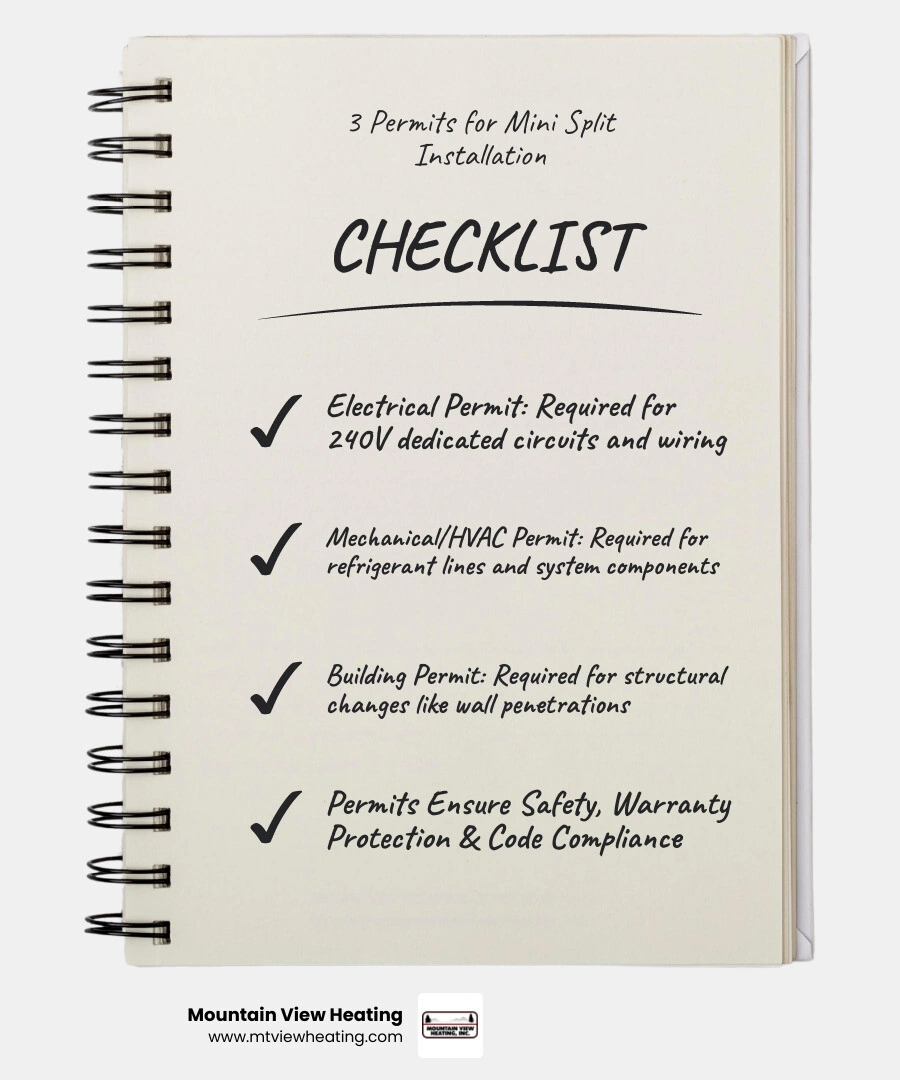
What permits are needed for mini split installation is one of the first questions you should answer before any work begins on your home. In most U.S. jurisdictions — including Bend, Oregon and surrounding Central Oregon communities — you will typically need up to three permits:
• Electrical permit – required for new 240V dedicated circuits and wiring
• Mechanical/HVAC permit – required for refrigerant lines and system components
• Building permit – required if the installation involves structural changes like wall penetrations or mounting modifications
Most homeowners are surprised to learn that skipping even one of these can lead to fines, voided warranties, insurance problems, and headaches when selling their home. Whether you're hiring a professional or considering a DIY approach, understanding the legal side of mini-split installation protects your home, your investment, and your family's safety.
The sections below walk you through each permit type, who's responsible for getting them, what the inspection process looks like, and what can go wrong if you skip the paperwork.
Do You Need a Permit to Install a Mini-Split System?

The short answer is a resounding yes. If you are adding a permanent heating and cooling system to your home, local building departments require documentation to ensure the work is done safely. Mini-splits are not like portable window units that you simply plug into an existing outlet; they are sophisticated mechanical systems that integrate directly into your home’s infrastructure.
By obtaining the proper permits, you are essentially inviting a neutral third party—a city or county inspector—to verify that the work meets current safety standards. This process ensures that your ductless mini-split system is installed in a way that won't cause electrical fires, refrigerant leaks, or structural instability.
• Safety Verification — Permitted Installation: Confirmed by professional inspection — Unpermitted Installation: No guarantee of safety
• Warranty Status — Permitted Installation: Fully protected by manufacturer — Unpermitted Installation: Often voided immediately
• Home Insurance — Permitted Installation: Covered in case of failure — Unpermitted Installation: Claims may be denied
• Resale Process — Permitted Installation: Smooth documentation for buyers — Unpermitted Installation: May require costly teardowns/fines
• Code Compliance — Permitted Installation: Up to date with latest standards — Unpermitted Installation: High risk of code violations
Understanding Local Jurisdiction in Central Oregon
Permit requirements aren't just a state-wide suggestion; they are governed by specific municipalities. In Bend, the requirements might slightly differ from the processes in Redmond or Sisters. For example, if you are looking into mini-split installation in Sisters, OR, you’ll be working with local building officials who follow the Oregon Residential Specialty Code.
Each city has its own fee schedule and application process. Some areas allow for "over-the-counter" permits that are issued the same day, while others may take a few business days to review your site plan. Regardless of whether you live in Sunriver or La Pine, the underlying goal remains the same: ensuring the installation is legal and safe for the residents.
Why Permits Matter for Homeowners
Beyond just "following the rules," permits provide a layer of property protection. When a permit is pulled, it creates a paper trail of professional accountability. If a system is installed incorrectly, the inspection process catches it before it becomes a hazard. This peace of mind is one of the top mini-split benefits for homeowners, as it ensures the longevity of the equipment. A properly permitted system is also a verified asset, adding real value to your home rather than a potential liability.
What Permits Are Needed for Mini Split Installation?
When we talk about what permits are needed for mini split installation, we are usually looking at a combination of specialized permissions. Because a mini-split involves high-voltage electricity, pressurized refrigerant, and holes drilled through your home's exterior, one single permit rarely covers everything.
Electrical Permits for Mini Split Installation
This is perhaps the most critical permit for safety. Most mini-split systems require a dedicated 240V circuit. This means we aren't just tapping into an existing bedroom outlet; we are running new, heavy-duty wiring from your main electrical panel to a new outdoor disconnect switch.
An electrical permit ensures that:
• The wire gauge is thick enough to handle the system's amperage.
• The circuit breaker is correctly sized to prevent overloads.
• The outdoor disconnect is weather-rated and accessible for service.
• All work complies with the National Electrical Code (NEC).
For homeowners in areas like Sunriver, OR, where homes may have specific aesthetic or structural requirements, ensuring the electrical run is code-compliant and discreet is a top priority.
Mechanical and Building Permits for Mini Split Installation
The mechanical permit covers the "guts" of the HVAC system. This includes the refrigerant lines (line sets) that carry the cooling and heating medium between the indoor and outdoor units. Inspectors check that these lines are properly insulated and that the system has been pressure-tested to prevent leaks of R-410A or R-32 refrigerants, which are regulated by federal law.
A building permit is often bundled with the mechanical permit, but it specifically addresses the structural side. If we are drilling a 3-inch hole through a load-bearing wall to connect the units, the building official wants to know that the structural integrity of the wall isn't compromised. It also covers the mounting of the indoor unit to ensure it won't pull away from the drywall and the outdoor pad to ensure it's level and stable. In high-snow areas like La Pine or Redmond, the building permit might also specify that the outdoor unit must be elevated on a stand to stay above the snow line.
The Risks of Skipping the Permitting Process
It might be tempting to save a few dollars by skipping the permit, but the long-term risks far outweigh the short-term savings. Unpermitted work is a "red flag" that can haunt you for years. Beyond the risk of an electrical fire or a system that doesn't cool properly, there are significant financial ways a ductless mini-split system can save you money that disappear if the installation isn't legal.
Impact on Manufacturer Warranties
Major manufacturers like Mitsubishi, Lennox, and Carrier are very clear: their warranties are only valid if the system is installed by a licensed professional in accordance with local codes. If you have a compressor failure three years from now and the manufacturer discovers there was never a permit or a professional inspection, they can—and likely will—deny your warranty claim. Getting it done right the first time is one of the benefits of setting up a ductless mini-split system that protects your pocketbook for a decade or more.
Home Insurance and Resale Issues
If an unpermitted mini-split causes water damage from a clogged drain line or, worse, an electrical fire, your homeowner's insurance company may refuse to pay the claim. They view unpermitted work as an "undisclosed risk."
Furthermore, when you go to sell your home in Bend or Redmond, the buyer's home inspector will likely check for permits. If they find the HVAC system was "bootlegged," the buyer can demand that you permit it retroactively. This often involves paying double or triple the original permit fees in "investigation fees," and you might even have to tear out drywall so the inspector can see the wiring. It can delay or even kill a home sale entirely.
Who is Responsible for Obtaining Permits?
In a professional installation, the responsibility for obtaining permits almost always falls on the licensed HVAC contractor. When we handle mini-split installation in Bend, OR, we manage the paperwork from start to finish.
The Role of a Licensed HVAC Technician
A licensed technician does more than just turn wrenches. We act as your liaison with the building department. This includes:
• Calculating Loads: Ensuring the unit is the right size for your room.
• Creating Site Sketches: Showing exactly where the units will be placed.
• Filing Applications: Navigating the online or in-person permit portals.
• EPA Certification: Every one of our technicians is EPA Section 608 certified, which is a federal requirement for handling the refrigerants inside a mini-split. It is actually illegal for a non-certified person to "break the seal" on a refrigerant system.
DIY Installations and Legal Requirements
While "DIY-friendly" kits exist on the market, they do not exempt you from the law. Even if you buy a pre-charged system, you still need an electrical permit for the wiring and a mechanical permit for the installation.
Many homeowners find that by the time they pay for the permits, rent the specialized vacuum pumps and gauges, and spend a weekend struggling with the install, they haven't saved much money—and they still have no warranty. If you choose the DIY route, you are personally liable for any code violations or safety hazards created during the process.
What to Expect During the Inspection Process
Once the installation is complete, the final step is the inspection. This is nothing to be nervous about if the work was done correctly. The inspector is there to be a second set of eyes for your safety.
The Rough-In and Final Inspection
In some cases, there are two stages. The "rough-in" happens before any walls are closed up (though with most mini-splits, this isn't necessary unless you are running lines through a finished attic or crawlspace). The "final" inspection happens once the system is up and running.
The inspector will typically check:
• Wiring: Ensuring the correct wire gauge and secure connections.
• Drainage: Verifying the condensate drain line is sloped downward so water doesn't back up into your house.
• Line Set Insulation: Checking that the copper lines are fully wrapped to prevent energy loss and condensation.
• Mounting: Making sure the outdoor unit is secure and won't vibrate or tip over.
Common Reasons for Inspection Failure
Even well-intentioned DIYers often fail inspections for simple mistakes. Common issues include:
1. Wrong Wire Gauge: Using 14-gauge wire when the manufacturer requires 12-gauge.
2. Improper Clearances: Mounting the outdoor unit too close to a wall, which chokes the airflow and kills efficiency.
3. Unsealed Holes: Failing to use proper weather-rated sealant where the line set enters the house.
4. No Disconnect: Forgetting the required electrical shut-off box within sight of the outdoor unit.
Frequently Asked Questions about Mini Split Permits
Can I install a mini-split myself without a permit in Oregon?
Legally, no. While you can physically do the work, Oregon law requires permits for the electrical and mechanical portions of the install. If you are caught, you can face significant fines from the building department.
How long does it typically take to get permit approval in 2026?
In Central Oregon, most electrical and mechanical permits can be issued within 1 to 5 business days. Many municipalities now offer online portals that speed up the process significantly compared to years past.
Do permits affect my home insurance premiums?
Usually, they don't increase your premiums, but they do protect your coverage. In fact, upgrading to a modern, energy-efficient system with a permit might even qualify you for certain "green home" discounts with some insurers, though you'd need to check with your specific agent.
Conclusion
Navigating what permits are needed for mini split installation doesn't have to be a headache. While the legal requirements might seem like extra work, they are there to protect the most important thing: your home and the people inside it.
At Mountain View Heating, we’ve spent over 40 years serving the Bend and Central Oregon community. We take the "customer-first" approach seriously, which means we handle all the permitting, licensing, and inspections for you. We want you to enjoy your new, energy-efficient comfort without ever worrying about code violations or voided warranties. Whether you're in Redmond, Sisters, or Sunriver, we're here to ensure your mini-split installation in Bend, OR is handled with 100% satisfaction. Give us a call today, and let’s get your home comfort project started the right way—legally and safely.