


Is Your Heat Pump Down? Here's Your Immediate Action Plan
When your heat pump fails in Bend's harsh winter or scorching summer, emergency heat pump repair in Bend, OR becomes your top priority. Whether you're waking up to a freezing home at 3 AM or coming back to a sweltering house after work, a broken heat pump isn't just inconvenient—it's a crisis that needs immediate attention.
Need emergency heat pump service right now? Here's what to do:
1. Turn off your system immediately if you smell burning or see smoke
2. Check your circuit breaker to rule out a simple power issue
3. Contact a 24/7 HVAC service that offers same-day emergency repairs in Bend
4. Note all symptoms (sounds, smells, error codes) to help your technician diagnose faster
5. Keep family members comfortable in one room while you wait for help
Bend's high desert climate means extreme temperatures year-round, and your heat pump works harder here than in most places. When it breaks down, you need a local team that understands Central Oregon's unique challenges and can respond fast.
For comprehensive information about heat pump services, visit our heat pump repair page, or contact Mountain View Heating for immediate emergency assistance.
Signs You Need Emergency Service Right Now
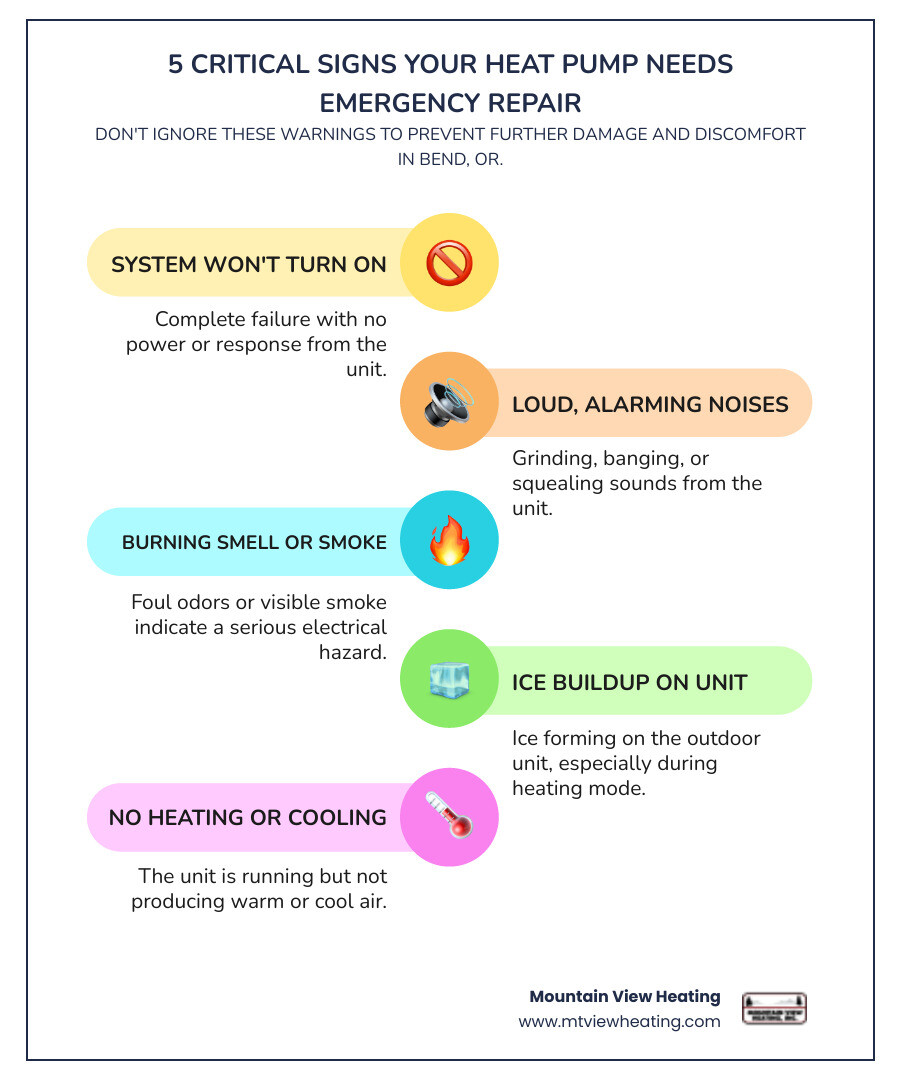
When your heat pump decides to take an unexpected vacation, it rarely does so quietly. Often, it gives us subtle (or not-so-subtle) hints that something is amiss before it completely gives up the ghost. Recognizing these signs early can sometimes prevent a total system shutdown, but more importantly, it helps you identify when you truly need emergency heat pump repair in Bend, OR. Ignoring these warnings can lead to more extensive damage, higher repair costs, and prolonged discomfort.
Here in Central Oregon, where temperatures can swing dramatically, a malfunctioning heat pump isn't just an inconvenience—it can be a health and safety concern. Whether it's the dead of winter and your home is rapidly cooling, or the peak of summer and your living space is becoming an oven, knowing these critical indicators will help you decide when to pick up the phone.
Here are the most common and urgent signs that your heat pump requires immediate professional attention:
• No Heat or Cool Air: This is often the most obvious and frustrating sign. If your thermostat is set correctly, but your heat pump is blowing air that isn't conditioned—meaning it's not heating in winter or cooling in summer—you have a significant problem. This could indicate a refrigerant leak, a failed compressor, a broken fan motor, or a serious electrical issue. In Bend's extreme climate, this isn't something you can put off.
• Strange Noises: Heat pumps are designed to operate relatively quietly. While you might hear the gentle hum of the fan or the whoosh of air, anything out of the ordinary should raise a red flag. Grinding, squealing, screeching, banging, or clanking noises are all indicators of mechanical failure, such as worn-out bearings, a loose fan blade, or a failing motor. These sounds usually mean components are rubbing together or breaking apart, and continued operation can cause catastrophic damage.
• Foul Odors: A burning smell is a clear sign of an electrical issue or an overheating motor, which we'll discuss in more detail below. However, other strange odors can also signal trouble. A musty smell might indicate mold growth in your ductwork or evaporator coil, while a sweet, chemical odor could point to a refrigerant leak. Any unusual smell coming from your vents or unit warrants investigation.
• Constant Cycling: Your heat pump should cycle on and off periodically to maintain your desired temperature. If it's turning on and off much more frequently than usual, a phenomenon known as "short cycling," it's a sign of inefficiency and potential problems. This could be due to an oversized unit, a dirty air filter, low refrigerant levels, or a malfunctioning thermostat. Short cycling puts immense strain on your system, leading to premature wear and tear and higher energy bills.
• Ice Buildup: While it's normal for the outdoor unit to develop a light layer of frost in cold weather (which it then defrosts), significant ice buildup on the coils, especially during heating mode, is a serious issue. This often indicates a problem with the defrost cycle, low refrigerant, or restricted airflow. A heat pump covered in ice cannot efficiently transfer heat, leading to a complete loss of heating capacity and potential damage to the compressor.
• Electrical Issues: Flickering lights when the heat pump turns on, frequently tripped circuit breakers dedicated to the unit, or a complete power loss to the system are all signs of electrical problems. These issues can be dangerous and should always be addressed by a professional.
For more detailed insights into various heat pump issues and how we can help, visit our More info about heat pump services.
Your System Won't Turn On At All
This is perhaps the most straightforward and alarming symptom: your heat pump is completely unresponsive. You adjust the thermostat, but nothing happens. No fan, no hum, no warmth, no cool air. It's just... dead. This complete system failure is a definitive emergency.
First, check your thermostat. Is it set to the correct mode (heat/cool) and temperature? Are the batteries dead if it's a wireless model? If the thermostat seems fine, the problem likely lies with the unit itself or its power supply. A tripped circuit breaker is a common culprit, cutting power to the unit. While this can sometimes be a quick fix by simply flipping the breaker back on, if it trips again immediately, it signals a deeper electrical issue that requires professional diagnosis. Power loss to the unit could also stem from wiring problems or internal component failures. A non-responsive heat pump is a major safety concern if the underlying issue is electrical, and it certainly leaves your home vulnerable to Bend's temperature extremes.
You Hear Loud, Alarming Noises
Your heat pump shouldn't sound like a monster under the bed. If you're hearing anything more than a gentle whir, it's time to call for emergency heat pump repair in Bend, OR. These sounds are often the system crying for help, indicating internal damage that can worsen rapidly if ignored.
• Grinding sounds: Often point to worn-out motor bearings in either the indoor or outdoor unit. If these bearings fail completely, the motor can seize up, leading to a much more expensive repair or even full unit replacement.
• Squealing or screeching: Can also be indicative of failing bearings or a loose fan belt (though less common in newer heat pumps). It could also be a sign that a fan motor is struggling.
• Banging or clanking: Typically suggests a loose or broken component. This could be a fan blade hitting something, a loose compressor component, or even an issue with the outdoor unit's casing. These noises are particularly concerning as they often mean parts are actively breaking or coming apart, potentially causing a cascade of damage.
Any of these loud, alarming noises signal that your heat pump is under severe stress. Continuing to run the system in this condition can turn a manageable repair into a complete breakdown, so immediate professional intervention is crucial.
There's a Burning Smell or Visible Smoke
This is arguably the most critical and potentially dangerous sign that demands immediate action. If you detect a burning smell—whether like burnt plastic, rubber, or electrical wiring—or worse, see visible smoke emanating from your heat pump unit or vents, shut off your system immediately. Do not wait.
A burning smell almost always indicates an electrical short, an overheating motor, or wires that are melting due to excessive heat. This is not only a sign of a severe mechanical failure but also a serious fire hazard. Electrical issues can quickly escalate from a pungent odor to a full-blown electrical fire, putting your home and family at risk. Even if the smell is faint, it's a warning that something is overheating.
After turning off the system at the thermostat and, if possible, at the circuit breaker, contact an emergency HVAC service right away. This situation requires prompt professional diagnosis and repair to ensure your safety and prevent further damage. We can't stress enough: safety first when it comes to burning smells or smoke.
What to Do Before Your Technician Arrives
When faced with a heat pump emergency, it's natural to feel a bit overwhelmed. But there are several proactive steps you can take that will not only ensure your safety but also help our technicians diagnose and resolve the issue more quickly once we arrive for your emergency heat pump repair in Bend, OR. Think of it as preparing the scene for the HVAC heroes!
Taking these steps can streamline the repair process, potentially saving you time and stress. Just remember, your safety is paramount, so never attempt repairs that involve opening the unit or working with electrical components.
Steps Before Your emergency heat pump repair in bend, or Technician Arrives
1. Turn Off the System: This is the golden rule, especially if you hear alarming noises, smell burning, or see smoke. Go to your thermostat and switch the system to "Off." If the issue seems electrical, or if you're concerned about further damage, it's wise to also switch off the dedicated circuit breaker for your heat pump at your electrical panel. This prevents any further operation that could worsen the problem or create a safety hazard.
2. Check the Air Filter: A surprisingly common culprit for heat pump issues is a clogged air filter. A dirty filter restricts airflow, forcing your heat pump to work harder, which can lead to overheating, reduced efficiency, and even system shutdowns. Check your filter and, if it's visibly dirty, replace it with a clean one. While this might not solve a major breakdown, it's a good first step and helps rule out a simple cause.
3. Ensure Vents Are Open: Walk around your home and make sure all supply and return vents are open and unobstructed by furniture, rugs, or curtains. Blocked vents can restrict airflow, leading to uneven heating/cooling and putting strain on your system.
4. Note the Symptoms: Be a detective! The more information you can provide our technician, the faster they can pinpoint the problem.
— What exactly happened? Did it make a noise, give off a smell, or simply stop working?
— When did the problem start? Was it sudden or gradual?
— What specific noises did you hear (grinding, squealing, banging)?
— What kind of smell did you detect (burning, musty, sweet)?
— Are there any error codes displayed on your thermostat or outdoor unit?
— Have you noticed any ice buildup on the outdoor unit?
— Did the circuit breaker trip?Write down these details; it will be invaluable for the diagnostic process.
5. Clear a Path to the Unit: Make sure our technicians have easy and safe access to both your indoor and outdoor heat pump units. Remove any obstructions, clutter, or debris that might be around the units. In winter, clear snow and ice from around the outdoor unit. This allows us to work efficiently and safely.
What NOT to Do With a Broken Heat Pump
Just as important as knowing what to do is knowing what not to do. Attempting to fix complex issues yourself can be dangerous and often leads to more extensive and costly repairs.
• Don't Ignore Strange Sounds or Smells: These are your heat pump's distress signals. Ignoring them in hopes the problem will magically disappear is a recipe for disaster. What might be a minor fix now could become a major component replacement if the system is allowed to continue operating under stress.
• Don't Keep Resetting the System: If your circuit breaker trips repeatedly, or if your system keeps shutting down shortly after you restart it, there's a fundamental problem that needs professional attention. Continuously resetting it can put stress on electrical components, potentially causing further damage or creating a fire hazard.
• Don't Attempt Electrical Repairs: Unless you are a certified HVAC technician or electrician, do not open your heat pump's electrical panel or attempt to fix wiring issues. High voltage can be deadly. Leave all electrical work to the experts who have the training and tools to do it safely.
• Don't Use a Pressure Washer on a Frozen Unit: While ice buildup is a problem, using a pressure washer or chipping away at the ice can severely damage the delicate fins and coils of your outdoor unit. This can lead to refrigerant leaks and expensive repairs. Instead, ensure the unit's defrost cycle is working (or call us if it's not) and gently remove any snow accumulation.
By following these guidelines, you'll not only protect your home and yourself but also help us provide the most efficient and effective emergency heat pump repair in Bend, OR when we arrive.
How to Choose a Fast & Reliable Service for Emergency Heat Pump Repair in Bend, OR
When your heat pump calls it quits, you don't just need any repair service; you need a fast, reliable, and experienced team that understands the unique demands of Central Oregon. Finding the right professionals for emergency heat pump repair in Bend, OR can make all the difference in restoring your home's comfort quickly and effectively. Here's what to look for when you're in a pinch:
At Mountain View Heating, we pride ourselves on providing exceptional service that meets these critical criteria, ensuring that when you need us most, we're there for you. Our unique selling proposition is prioritizing 100% customer satisfaction for all projects, big or small, and that commitment truly shines when you're facing an unexpected breakdown.
Look for 24/7 Availability
Heat pump emergencies rarely happen during convenient business hours. They strike on the coldest winter night, the hottest summer afternoon, or right in the middle of a holiday weekend. That's why 24/7 availability is non-negotiable for an emergency service.
• After-hours service: A reputable company will have technicians on standby to respond to calls outside of standard 9-to-5. This means you won't be left shivering or sweating until the next business day.
• Weekend and holiday repairs: Life doesn't stop for weekends or holidays, and neither do HVAC emergencies. Look for a service that operates every day of the year, ensuring you're never left in a lurch.
• Quick response time: True emergency service means a commitment to dispatching technicians promptly. When your comfort and safety are on the line, every hour counts. A company that boasts same-day service for emergencies is your best bet for a rapid resolution.
• Peace of mind: Knowing that professional help is just a phone call away, no matter the time or day, provides invaluable peace of mind when your heat pump unexpectedly fails.
Verify Local Expertise in Central Oregon
Bend, Oregon, isn't just any place; it's a high desert climate with unique challenges for HVAC systems. The extreme temperature fluctuations, the dry air, and even the specific types of dust and pollen can impact how heat pumps perform and wear over time. This is why local expertise is crucial.
• Knowledge of Bend's climate: A local service provider understands how the fierce winter cold and intense summer heat stress your heat pump. They know which components are most likely to fail under these conditions and how to properly size and maintain systems for optimal performance in our specific environment.
• High desert challenges: Our unique high desert environment presents specific issues, such as dust accumulation, which can clog coils and filters faster, or the need for robust defrost cycles in winter. Technicians familiar with these local nuances can diagnose problems more accurately and efficiently.
• Experience with local homes: Different homes in Bend, from older residences to new constructions, have varying insulation, ductwork, and system configurations. A local team will have experience with a wide range of these setups, allowing for faster and more effective troubleshooting.
• Faster arrival: Being local means our team can get to your home in Bend, Crooked River Ranch, La Pine, Prineville, Redmond, Sisters, Sunriver, or Terrebonne much faster than a company based out of a distant city. When you need emergency heat pump repair in Bend, OR, proximity matters.
When you choose a company with deep roots and experience in Central Oregon, you're not just getting a repair; you're getting a solution custom to the specific demands of our beautiful, yet challenging, environment.
Frequently Asked Questions about Heat Pump Emergencies
When your heat pump acts up, it's natural to have a lot of questions. We've compiled some of the most common inquiries we receive regarding heat pump emergencies to help you better understand your system and how to prevent future breakdowns.
How can I prevent future heat pump emergencies?
An ounce of prevention is worth a pound of cure, especially when it comes to your heat pump. Proactive maintenance is the single best way to avoid unexpected breakdowns and the need for emergency heat pump repair in Bend, OR.
• Regular Maintenance: Schedule professional tune-ups at least once a year, ideally in the spring for cooling and fall for heating. During these visits, our technicians will clean coils, check refrigerant levels, inspect electrical connections, lubricate moving parts, and identify potential issues before they become emergencies. This not only prevents breakdowns but also extends the lifespan of your unit and maintains its efficiency.
• Seasonal Tune-ups: These targeted check-ups ensure your system is ready for the demands of the upcoming season. For instance, making sure your heat pump's defrost cycle is working correctly before winter hits can prevent costly ice buildup issues.
• Clean Filters: This cannot be stressed enough. A dirty air filter is the most common cause of heat pump inefficiency and can lead to a host of problems, including reduced airflow, coil freezing, and overheating. Check your filter monthly and replace it every 1-3 months, or more often if you have pets or allergies.
• Clear Outdoor Unit: Keep the area around your outdoor unit free of debris, leaves, grass clippings, and snow. Ensure there's at least two feet of clearance on all sides to allow for proper airflow.
• Don't Block Vents: Ensure all indoor supply and return vents are open and unobstructed to maintain proper airflow throughout your home.
For more information on keeping your home comfortable year-round, explore our More info about heating services and More info about cooling services.
Is my heat pump problem an actual emergency?
It can be tough to distinguish between a minor hiccup and a true emergency. While any heat pump issue can be frustrating, some situations demand immediate attention for safety or to prevent further damage. Here are scenarios that typically warrant emergency heat pump repair in Bend, OR:
• No Heating in Winter: In Bend's freezing winter temperatures, a lack of heat is a serious safety concern, especially for vulnerable individuals like the elderly, young children, or those with health conditions. Freezing pipes are also a risk. This is a definite emergency.
• No Cooling in Extreme Heat: Similarly, during Bend's hot summer days, a non-functional cooling system can lead to heatstroke and discomfort, particularly if indoor temperatures climb to unsafe levels.
• Electrical Hazards: Any signs of an electrical problem, such as burning smells, visible smoke, sparks, or frequently tripped circuit breakers, are immediate emergencies. These pose a significant fire risk and should be addressed by a professional immediately after you've safely shut down the system.
• Major Water Leaks: While heat pumps produce some condensation, a significant water leak can indicate a serious problem, potentially leading to water damage in your home or electrical hazards.
• Loud, Alarming Noises: As discussed earlier, grinding, banging, or screeching sounds indicate internal mechanical failure that can quickly escalate if the system continues to run.
If you're ever in doubt, it's always safer to call a professional. We can help you determine the urgency and dispatch a technician if needed.
Why did my heat pump stop working suddenly?
A sudden heat pump breakdown can be startling. There are several common reasons why your system might unexpectedly cease operation:
• Tripped Breaker: This is often the simplest explanation. An electrical surge, an overworked unit, or a short circuit can cause the circuit breaker dedicated to your heat pump to trip, cutting power. Check your electrical panel and reset the breaker. If it trips again, there's a deeper electrical issue.
• Clogged Filter: A severely clogged air filter can restrict airflow so drastically that it causes the unit to overheat and shut down as a safety measure. It can also lead to ice buildup on the coils, which prevents the system from operating effectively.
• Thermostat Malfunction: Your thermostat is the brain of your HVAC system. If it's faulty, has dead batteries, or is incorrectly programmed, it might not be sending the correct signals to your heat pump, causing it to appear "dead."
• Refrigerant Leak: Refrigerant is the lifeblood of your heat pump, responsible for transferring heat. If there's a leak, the system will lose its ability to heat or cool efficiently, eventually leading to a shutdown. Signs of a leak include reduced performance, ice buildup on coils, and a hissing sound.
• Compressor Failure: The compressor is one of the most critical and expensive components of a heat pump. If it fails, your system essentially loses its ability to move heat, resulting in a complete lack of heating or cooling. This often manifests as loud grinding noises before complete failure.
• Fan Motor Issues: If either the indoor (blower) or outdoor (condenser) fan motor fails, airflow will be compromised, leading to overheating and system shutdown.
• Electrical Component Failure: Beyond the circuit breaker, other electrical components like capacitors, contactors, or wiring can fail, interrupting the power supply or communication within the unit.
Identifying the exact cause requires professional diagnosis, but understanding these common culprits can help you communicate the problem more effectively to your technician.
Get Your Comfort Back Today
Don't let a malfunctioning heat pump leave you shivering in the cold or sweltering in the heat of Bend, OR. We understand that when your comfort system goes down, it's more than an inconvenience—it's an urgent situation that impacts your daily life and peace of mind. That's why we're committed to providing prompt, professional, and reliable emergency heat pump repair in Bend, OR.
You don't have to wait days for a solution. Our team is ready to provide fast and reliable service, ensuring that your heat pump issues are addressed quickly and correctly. We stand by our promise of 100% customer satisfaction for all our projects, big or small, because your comfort is our top priority.
When you need immediate assistance from a trusted local expert, remember Mountain View Heating. We're here to help you restore comfort to your home with efficient and effective heat pump repairs.
Contact us for immediate heat pump repair and let us help you get your comfort back today.